Infrared Roof Scanning Tampa
Commercial roof infrared thermography scanning across the Tampa Bay metro - post-sunset thermal imaging to locate moisture-saturated insulation, aerial and ground-based scan options, written reports with thermal image overlays, and FBC HVHZ context.
Infrared roof scanning on a Tampa Bay commercial building requires timing and conditions that are very specific to this market. Tampa's daily afternoon rain cycle, the Gulf-driven humidity, and the Gulf of Mexico's moderating effect on nighttime temperature recovery all affect when a scan produces usable thermal contrast. Understanding the local weather pattern is as important as operating the instrument.
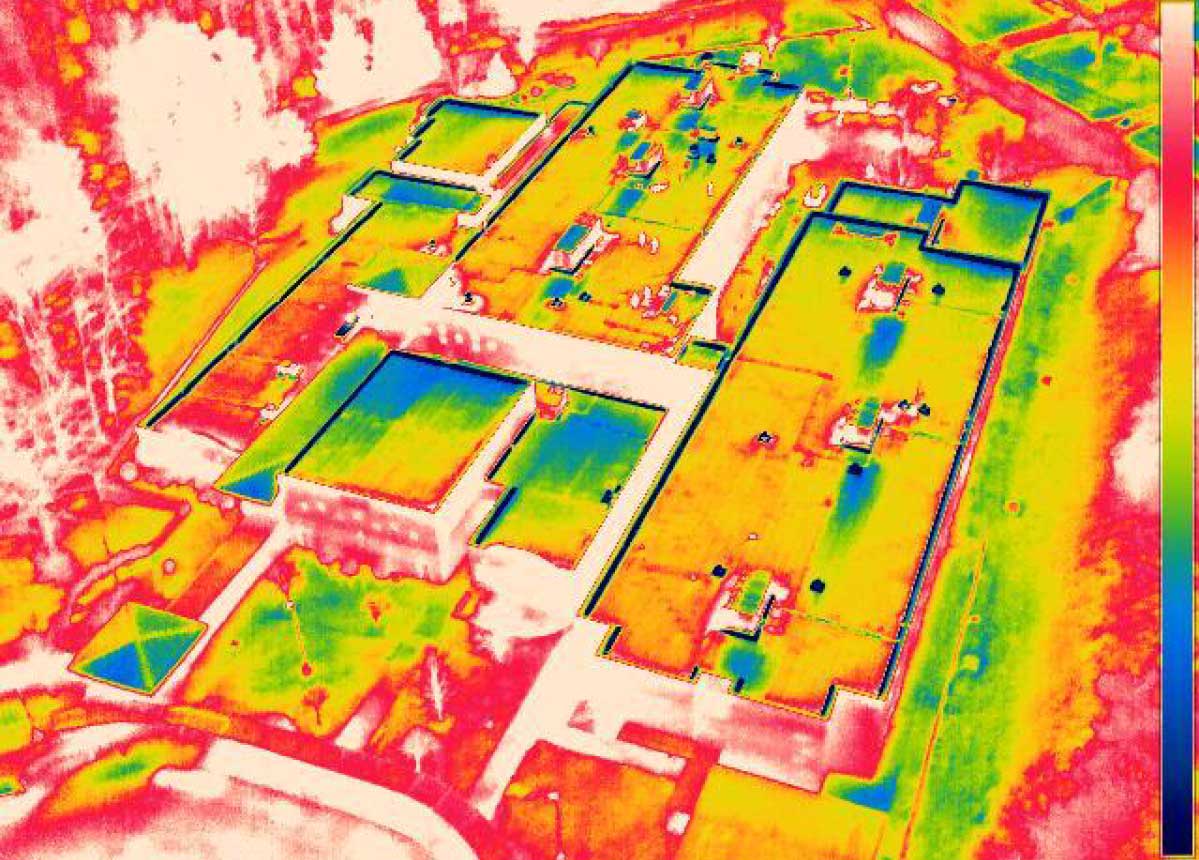
Infrared roof scanning works by detecting the thermal mass differential between dry and wet insulation during the roof's nighttime cooling cycle. Wet insulation retains heat longer than dry insulation - the moisture's thermal mass delays the cooling of the wet areas relative to the dry areas, producing a warm spot visible on the thermal image during the post-sunset cooling window. The quality of the scan depends on how well the roof heated during the day, how much cloud cover interrupted the solar loading, and whether the nighttime air temperature is dropping fast enough to produce meaningful thermal contrast.
Tampa Bay's weather pattern creates specific scanning challenges. The afternoon thunderstorm cycle from June through September clouds the sky during the peak solar loading period, reducing the temperature differential between wet and dry insulation that produces a clear scan. Post-storm cloud cover can persist through the night, reducing nighttime cooling rate. And Tampa Bay's Gulf-moderated nighttime temperatures in the summer months - rarely dropping below 75°F even at 3 AM - limit the total thermal contrast available for the scan. Scheduling infrared scans in Tampa Bay requires monitoring the National Weather Service Tampa Bay Area forecast discussion for the specific day, identifying nights that follow a clear afternoon, and understanding that the October through April window is reliably more productive than the summer storm season.
From our Downtown Tampa office, I schedule and conduct infrared roof scans on commercial buildings across the Tampa Bay metro - Hillsborough and Pinellas Counties, including the downtown Riverwalk office buildings, the Westshore Class A cluster, the Ybor City historic commercial inventory, and the large-footprint industrial buildings along the TIA ring and Port Tampa Bay corridors. The deliverable is a thermal image set overlaid on the roof zone diagram, a written interpretation of the findings, and a recommended scan-to-scope response.
Infrared Scan Protocol for Tampa Bay Commercial Roofs
The standard infrared roof scan protocol starts at least 30 minutes after sunset and continues until the thermal contrast between wet and dry insulation begins to diminish - typically a two- to three-hour window on a good scan night in Tampa Bay. The scan is conducted from the roof surface using a calibrated forward-looking infrared camera, with the camera operator walking a systematic grid pattern that ensures full coverage of the roof area. For large-footprint buildings where roof surface scanning would require excessive setup time or access complexity, aerial drone-mounted infrared imaging is available as an alternative - with the drone operating at low altitude after sunset to capture the thermal image set.
The scan captures thermal images at regular intervals along the grid transects, with GPS coordinates embedded in the image metadata for precise location reference. Warm anomalies in the thermal image - the heat retention signature of wet insulation - are flagged in real time and confirmed with a spot-check capacitance reading at the anomaly location. Confirmed wet anomalies are marked on the roof zone diagram for the written report.
Tampa Bay-specific scan timing adjustments: we avoid scheduling scans on nights that follow an afternoon thunderstorm, even if the sky clears by sunset - the rain event interrupts solar loading and reduces the temperature differential available for the scan. We avoid scheduling in the week after a hurricane or tropical storm, when cloud cover and rainfall have suppressed solar loading across multiple days. The best scan windows in the Tampa Bay market are clear, sunny days in October through April, when the afternoon sea breeze clears any morning cloud by midday and the nighttime temperature drop of 15 to 20 degrees from the daytime high produces strong thermal contrast.
Infrared vs. Capacitance Scanning - Choosing the Right Method
Infrared and capacitance scanning are not competing methods - they are complementary methods that are appropriate for different conditions. Infrared scanning is best suited for large-footprint roofs where full-grid capacitance scanning would be time-prohibitive, for roofs where the membrane type or surface condition makes capacitance scanning unreliable (ballasted EPDM, for example), and for post-storm surveys where a rapid large-area assessment is needed before interior damage progresses.
Capacitance scanning is more reliable for smaller roofs, for roofs with limited solar loading history that makes thermal contrast poor, and for year-round scanning regardless of weather conditions - capacitance readings do not depend on solar loading or nighttime temperature drop. For Tampa Bay commercial buildings in the 10,000 to 50,000 square foot range, capacitance scanning is often the more reliable first-pass method; for buildings above 100,000 square feet in the TIA-adjacent industrial corridor or Port Tampa Bay logistics district, aerial infrared scanning is often the more efficient method.
Many Tampa Bay moisture surveys use both methods in sequence: a first-pass aerial infrared scan to identify the general pattern of moisture anomalies across the full roof area, followed by a ground-level capacitance scan at higher grid density in the anomaly zones to precisely map the wet area boundaries, followed by core pulls to confirm the capacitance readings. This three-step approach is most appropriate for large-footprint buildings where the cost of a full capacitance grid scan can be reduced by triage from the infrared scan.
Roof review
Get a written Tampa Bay commercial roof scope.
We document the roof condition, separate urgent repairs from capital work, and give ownership a practical path before money gets spent.