
Silicone Roof Coating Tampa Bay
Silicone roof coating restoration for Tampa Bay commercial buildings - substrate eligibility assessment, FBC coating compliance, salt-air ponding water performance, and manufacturer warranty-quality application.
Silicone coating is a legitimate and cost-effective restoration scope for eligible Tampa Bay commercial roofs - and a scope that is routinely oversold and misapplied. Substrate eligibility, dry insulation verification, and application quality are what separate a ten-year warranted restoration from a coating that fails in the first Tampa Bay hurricane season.
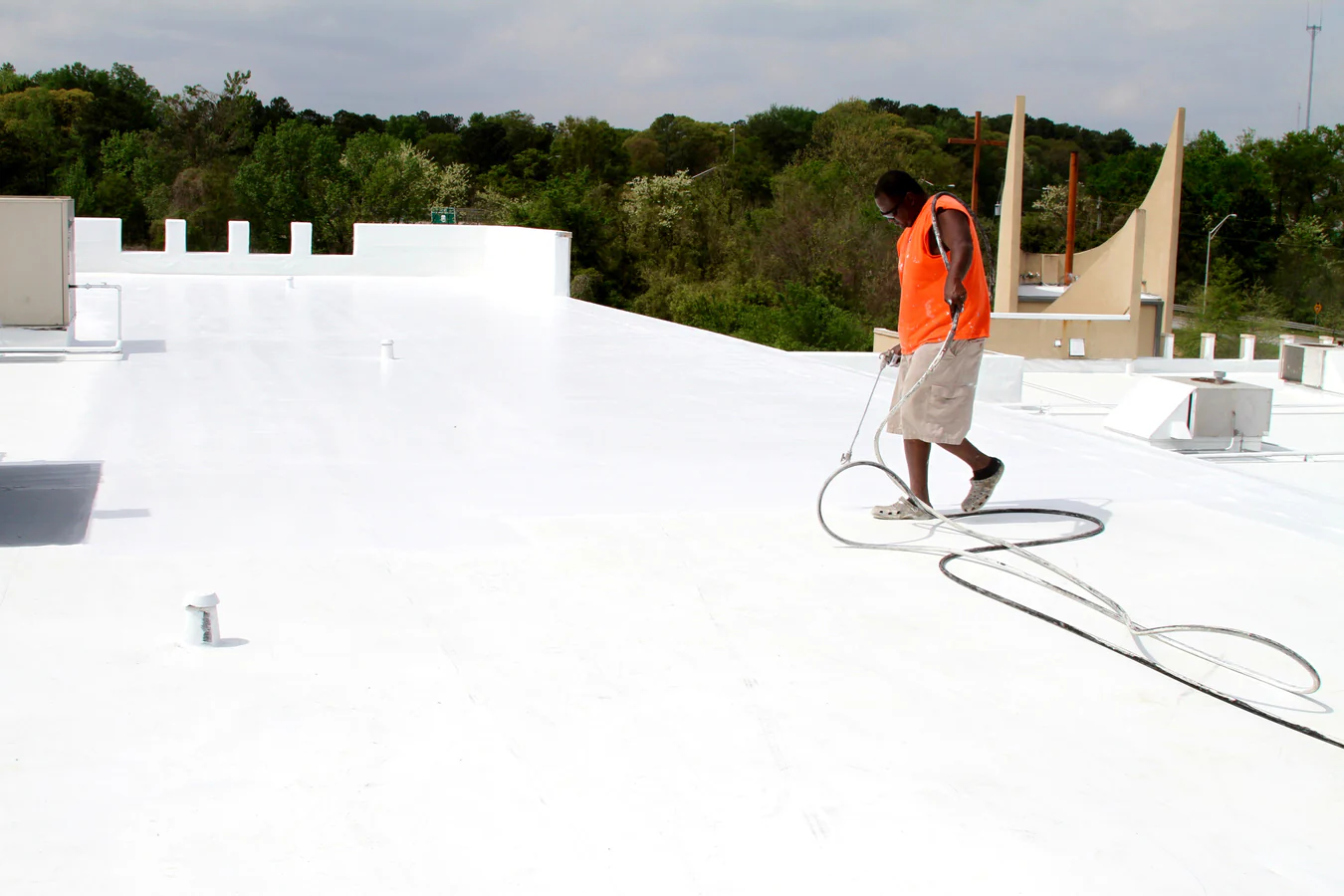
Silicone coating restoration - applying a fluid-applied silicone membrane over an existing commercial roofing substrate - is the most actively marketed commercial roof scope in the Tampa Bay market, and it is also the scope where the gap between what is promised and what is installed is widest. A correctly specified and applied silicone coating system on an eligible substrate extends the service life of the existing roof by ten to fifteen years, provides a new manufacturer warranty, and produces a measurable cool-roof performance improvement by increasing the roof surface solar reflectance. An incorrectly specified silicone coating applied over a saturated insulation substrate or an incompatible membrane surface fails within three to five years without providing any of those benefits.
The substrate eligibility determination is the most important decision in a silicone coating project. Silicone will bond to TPO, EPDM, PVC, modified bitumen cap sheet, smooth BUR surface, metal, and concrete - in each case with specific surface preparation requirements. Silicone will not restore a membrane with saturated insulation beneath it, because the moisture in the insulation drives vapor through the membrane under Tampa Bay's solar heat load and causes the coating to blister and delaminate. Before any coating project we pull moisture cores at five to ten locations. If more than ten to fifteen percent of cores read wet, coating is not the correct scope.
Tampa Bay's climate creates specific silicone coating performance advantages. Silicone maintains flexibility across Tampa Bay's temperature range - from the 95-degree summer roof surface temperature to the occasional winter morning cold snap - without the plasticizer migration issues that affect some other fluid-applied coatings. Silicone is resistant to ponding water - a significant advantage in Tampa Bay's flat-roof environment where the combination of high rainfall volume and typical low-slope drainage geometry creates ponding zones that can hold water for 48 hours after a rain event. Most acrylic and polyurethane coatings degrade from sustained ponding water exposure. Silicone does not.
Silicone Coating Eligibility Assessment for Tampa Bay Roofs
The eligibility assessment for a silicone coating project in Tampa Bay starts with a roof walk to document surface condition, seam condition, flashing condition, and drainage pattern. Surface conditions that make coating ineligible: active seam delamination, flashing separation at more than isolated points, membrane punctures, and any visible evidence of moisture intrusion below the membrane. Coating applied over active seam failures encapsulates the failure point without repairing it - the failure continues beneath the coating and drives insulation saturation that causes the coating to blister in Tampa Bay's solar heat.
Before coating application, all seam delaminations must be repaired, all penetration flashings must be inspected and re-sealed where needed, all drain bowls must be cleaned and confirmed functional, and all ponding water drainage patterns must be evaluated against Tampa Bay's rain rate. A roof that holds standing water for more than 48 hours after a rain event - the standard FBC drainage standard - needs drain supplementation before coating, not after. Coating over a drainage problem defers the problem until the next heavy rain event and then delivers a warranty claim conversation with the manufacturer that rarely ends favorably for the building owner.
Surface preparation before silicone application in Tampa Bay's humid subtropical climate requires specific attention to temperature, humidity, and residue condition. Silicone adhesion to TPO requires a clean, dry surface with surface temperature above 50 degrees - easily met in Tampa Bay - and relative humidity below 85 percent at the time of application. Tampa Bay's summer morning humidity frequently exceeds this threshold, and midday application windows in the summer season are constrained by afternoon storm risk. We schedule coating application for morning hours on low-humidity days during the Tampa Bay thunderstorm season and hold production when the morning relative humidity exceeds the manufacturer's adhesion specification.
Application Quality and Mil Thickness for Warranted Silicone Systems
Silicone coating manufacturer warranties for ten or more years require a minimum applied dry film thickness - typically 20 to 25 mils for a ten-year warranty, 30 mils or more for a fifteen-year warranty - measured and documented during application. Application at less than the warranted mil thickness is the most common reason coating warranties are voided during the first manufacturer warranty audit. In Tampa Bay's high-UV, high-rainfall environment, under-applied silicone coating shows degradation at the seams and flashing terminations within three to five years.
We measure wet film thickness during application with a wet mil gauge at documented intervals - typically every 1,000 square feet - and record the measurements in the daily application log. The application log becomes part of the project closeout documentation and is the primary evidence if a warranty claim requires thickness verification. If wet film thickness readings during application fall below the warranted minimum, we add additional material in the same application window rather than leaving a deficiency for the warranty documentation to defend.
Seam and flashing reinforcement is required under the silicone coating at every seam and penetration location. Reinforcement fabric - typically a polyester or fiberglass mesh embedded in the base coat silicone before the finish coat - bridges the seam joint and prevents coating cracking at the seam edge from thermal movement. Tampa Bay's daily thermal cycling - surface temperatures that swing 50 degrees or more from pre-dawn to peak afternoon - is more aggressive than the thermal cycling in most inland markets, and unreinforced silicone at seam locations is a predictable failure point in this climate without the reinforcement fabric.
Roof review
Get a written Tampa Bay commercial roof scope.
We document the roof condition, separate urgent repairs from capital work, and give ownership a practical path before money gets spent.