
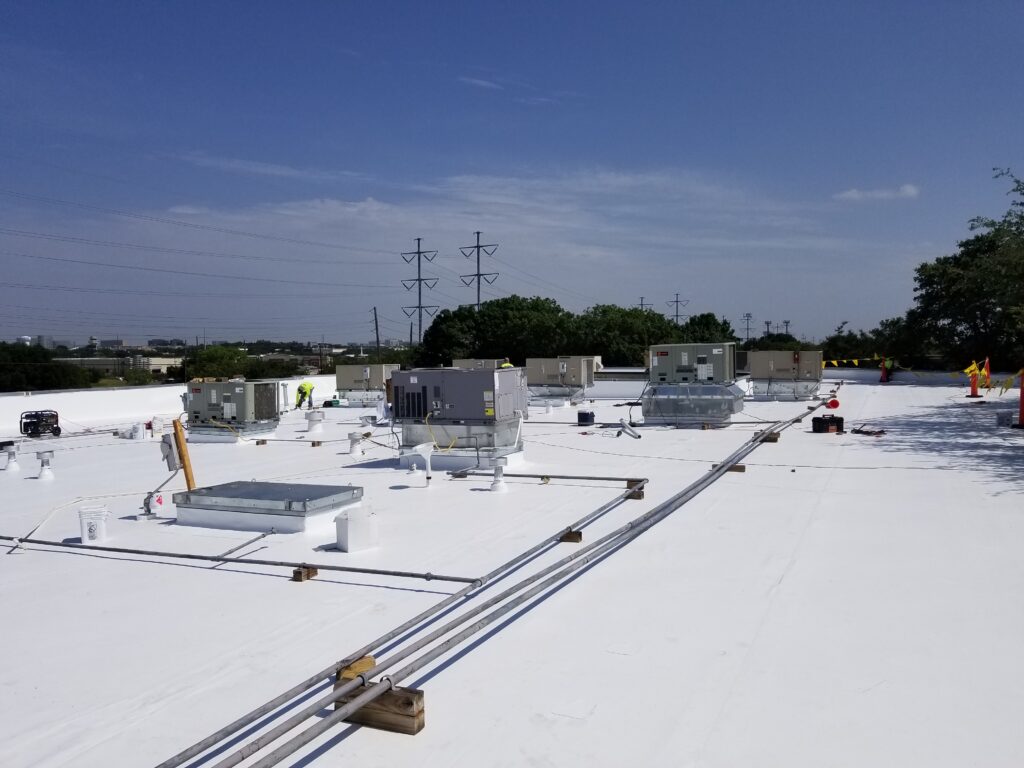
TPO Roof Systems Tampa Bay
Thermoplastic polyolefin roofing for Tampa Bay commercial buildings - Miami-Dade NOA-approved assemblies, FBC HVHZ wind-uplift fastener patterns, salt-air corrosion specification, and hurricane-readiness documentation.
TPO is the dominant single-ply membrane in the Tampa Bay commercial market - and also the system most commonly installed without the Miami-Dade NOA-approved fastener engineering that the Florida Building Code High-Velocity Hurricane Zone provisions actually require. We install TPO with the zone-differentiated fastener pattern, NOA-approved assembly configuration, and salt-air hardware specification the coastal Tampa Bay environment demands.
Thermoplastic polyolefin has been the default commercial flat-roof membrane in the Tampa Bay market since the mid-2000s, and the 45-mil and 60-mil systems installed across the Westshore business district, the TIA-adjacent industrial ring, and the Hillsborough suburban commercial corridors are now reaching the end of their original warranty life. That timing coincides with three consecutive major hurricane seasons - Ian (2022), Idalia (2023), Milton (2024) - that exposed a consistent failure pattern in the existing TPO inventory: perimeter and corner zone membrane separation on buildings where the fastener pattern was applied uniformly rather than engineered to the zone-differentiated design pressures that Florida Building Code HVHZ provisions require.
A correctly installed TPO system for a Tampa Bay coastal commercial building is not the same as a correctly installed TPO system in Atlanta or Houston. The Miami-Dade NOA approval that governs the assembly must match the specific membrane thickness, attachment method, insulation board product, and fastener spacing - not just the membrane brand. The ASCE 7 wind-uplift calculation for a Tampa building in Exposure C at 135 mph Basic Wind Speed produces perimeter design pressures roughly double the field pressure and corner pressures two and a half times the field pressure. A 12-inch field fastener row spacing extended uniformly to the perimeter and corner zones is under-fastened for those zones. After Hurricane Milton's 2024 Hillsborough track, we documented this exact failure in the Westshore corridor on buildings where TPO replacement had been done within the prior ten years.
When we specify a TPO system for a Tampa Bay commercial building, the process starts with the NOA selection - identifying which Miami-Dade-approved assembly configuration achieves the required design pressure for each roof zone at the available installed cost - and ends with a closeout package that includes the NOA number, the ASCE 7 calculation, the zone diagram with fastener pattern documentation, and the manufacturer warranty document. That closeout package is what protects the owner when the next storm event generates an insurance conversation.
Miami-Dade NOA Assembly Compliance for Tampa Bay TPO
Florida Building Code Section 1521 requires that every component of a roofing assembly installed on a building in the coastal HVHZ exposure zone carry a Miami-Dade NOA product approval for the specific configuration installed. For TPO, the NOA is membrane-specific, insulation-specific, and attachment-method-specific. A 60-mil TPO membrane from a given manufacturer installed mechanically attached over polyiso insulation does not carry the same NOA as the same 60-mil membrane installed fully adhered over the same insulation, or mechanically attached over a different insulation product. The wrong combination voids the NOA and voids the manufacturer warranty.
We maintain a current working library of NOA approvals for the major TPO manufacturers - Carlisle SynTec, GAF EverGuard, Firestone RubberGard, Johns Manville, Versico - and we specify assembly configurations that match the NOA approval table exactly. For Tampa Bay coastal buildings, we select assemblies where the NOA tested design pressure provides a meaningful margin above the calculated HVHZ required pressure, not just the minimum threshold.
For the corner zones of a typical two-story Westshore office building under the FBC 2023 wind map and Exposure C classification, the required design pressure is approximately -65 to -70 psf. Not every NOA-approved TPO assembly achieves this at standard fastener spacing. When the available NOA-approved mechanically attached assembly falls short of the corner zone requirement, we specify fully adhered for the corner zone only - a hybrid approach that keeps the field zone mechanically attached while meeting the corner requirement without over-specifying the entire roof.
Salt-Air Hardware Specification for Coastal Tampa Bay TPO
Standard galvanized roofing fasteners carry a design life rated for typical IBC weather exposure. That rating does not account for the salt-air environment within two to three miles of Tampa Bay and the Gulf of Mexico, where zinc oxidation progresses significantly faster than the rating assumes. Buildings in the Westshore corridor, Channelside, Port Tampa Bay adjacency, and the South Tampa commercial areas are in this salt-air zone. We specify hot-dipped galvanized fasteners with a heavier zinc coating weight or stainless steel fasteners for these buildings - not as an upgrade, but as the correct specification for the expected exposure.
Termination bar corrodes at the cut edge in coastal salt-air environments. Standard aluminum termination bar oxidizes at the ends within five years in a direct Tampa Bay coastal exposure, opening a gap between the bar and the membrane at the perimeter wall and parapet flashing lines. We specify stainless steel termination bar for coastal Tampa Bay TPO projects and seal the bar-to-membrane joint with a marine-grade elastomeric sealant. This detail is standard on our coastal specifications - not an upcharge.
Drain bodies and scupper boxes in the salt-air zone corrode at the seam welds faster than the manufacturer's rated service life predicts. We specify stainless steel or lead drain bodies and copper or stainless scuppers on Tampa Bay coastal TPO projects. The drain specification is documented in the closeout package so the building's maintenance team knows what is installed and can identify the correct replacement hardware when service is needed.
Roof review
Get a written Tampa Bay commercial roof scope.
We document the roof condition, separate urgent repairs from capital work, and give ownership a practical path before money gets spent.