
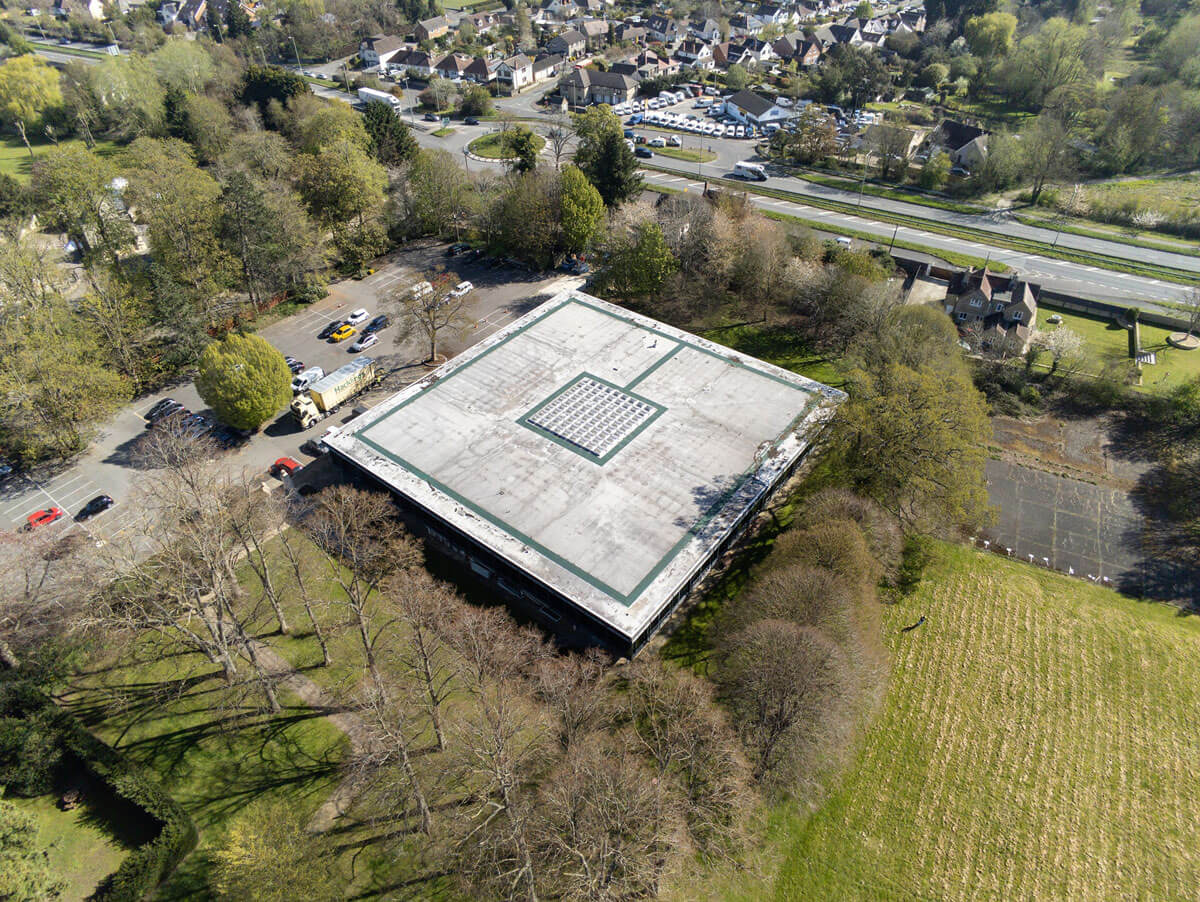
Roof Moisture Survey Tampa
Commercial roof moisture surveys across the Tampa Bay metro - nuclear and capacitance meter moisture mapping, moisture core pulls, insulation saturation assessment, and written findings reports for replacement scoping and insurance documentation.
Tampa Bay's subtropical humidity and extended thunderstorm season make insulation saturation the most common concealed roof defect in the market. A moisture survey is not optional when the recover-versus-replace decision is on the table - it is the data point that separates the honest scope from the one that voids the new warranty before the first year is out.
Moisture surveys in Tampa Bay are not an exotic diagnostic - they are routine because the conditions that produce insulation saturation are routine here. Tampa averages 47 inches of rainfall annually, most of it delivered in intense afternoon thunderstorms between June and September. A slow membrane failure - a seam that has crept open at a detail, a drain that is holding a quarter inch of standing water between rain events - keeps the insulation stack in a cycle of wetting and partial drying that, over two to three seasons, produces saturation levels that require core pull verification to quantify.
The recover-versus-replace decision is the most consequential scope question in commercial roofing, and a moisture survey is the evidence that makes it defensible. Recovering a saturated insulation stack traps the moisture, voids the new warranty, and almost always produces the same leak failure within five years - often faster. Replacing insulation that is dry adds cost without benefit. The survey tells you which is which, down to a mapped percentage of the total roof area. That percentage drives the scope and the budget.
I run moisture survey services for Tampa Bay commercial buildings as a standalone diagnostic service, as part of a replacement scope assessment, and as an annual maintenance inspection line item for buildings on our asset management program. The deliverable is a moisture map keyed to the roof zone diagram, a written interpretation of the findings, and a recommended scope response - replace the saturated sections, recover the dry sections, or replace the full roof if saturation exceeds the threshold where partial replacement is not economical.
Moisture Survey Methods for Tampa Bay Commercial Roofs
The primary non-destructive moisture survey methods for commercial flat and low-slope roofs are nuclear densitometry and capacitance-based electrical impedance measurement. Nuclear densitometry measures the hydrogen content of the insulation mass beneath the membrane - wet insulation has higher hydrogen content than dry insulation, and the density reading maps directly to moisture presence. Capacitance meters measure the electrical impedance of the insulation stack, which changes with moisture content. Both methods produce a grid-mapped reading set that identifies moisture anomalies that are then confirmed with moisture core pulls at suspect locations.
For Tampa Bay roofs, capacitance scanning is our standard first-pass method on TPO, EPDM, and PVC membrane roofs - the non-metallic membrane allows the instrument to read through the membrane to the insulation below. Nuclear densitometry is specified for modified bitumen and built-up roofing where the membrane layers or embedded aggregate interfere with capacitance readings. For very large-footprint buildings in the TIA-adjacent industrial ring - 200,000 square foot or larger distribution centers where a full grid scan would require multiple days - we triage with capacitance scanning along systematic transects and concentrate the closer grid spacing in the areas where the transect readings indicate suspect moisture.
Core pulls are the confirmatory step for any wet reading above the threshold that triggers the recover-versus-replace decision. We pull cores in a minimum of five locations, and in additional locations at each significant wet-reading cluster. The core pull exposes the insulation stack and allows direct observation of moisture level - surface wet, partially saturated, or fully saturated through the insulation thickness. Core results are documented with photographs, moisture meter readings on the exposed insulation face, and location coordinates on the roof zone diagram. The core locations are patched immediately after sampling.
Tampa Bay's Subtropical Climate and Insulation Saturation Patterns
Tampa Bay's subtropical climate produces a saturation pattern on commercial roofs that is distinct from what you see in drier or cooler climates. In a climate with a distinct dry season, moisture that enters the insulation stack through a slow membrane failure has an opportunity to partially dry out during the dry months. Tampa's average monthly relative humidity stays above 60 percent throughout the year, with summertime values routinely above 80 percent. The insulation stack that begins absorbing moisture in June's first thunderstorm season never fully dries before the next season begins.
The practical result is that Tampa Bay commercial roofs can accumulate significant insulation saturation over two to three seasons from a membrane failure that would not produce a visible leak - or would produce an intermittent leak that the building operator attributed to other sources - until the saturation has progressed across a large percentage of the roof area. We regularly find saturation levels of 30 to 40 percent of roof area on Tampa Bay commercial buildings where the building operator was aware of an occasional slow drip but did not recognize the scope of the underlying saturation.
Post-hurricane saturation has a different pattern from chronic saturation. A hurricane event that produces roof damage followed by even 24 to 48 hours of exposure before dry-in can introduce large volumes of water directly into the insulation stack across a wide area. Post-storm saturation appears on the moisture map as a contiguous wet zone rather than the scatter-pattern of chronic slow-leak saturation. The distinction is relevant for insurance documentation purposes - concentrated post-storm saturation is more clearly attributable to the storm event, while scatter-pattern chronic saturation may be contested as pre-existing condition.
Roof review
Get a written Tampa Bay commercial roof scope.
We document the roof condition, separate urgent repairs from capital work, and give ownership a practical path before money gets spent.