
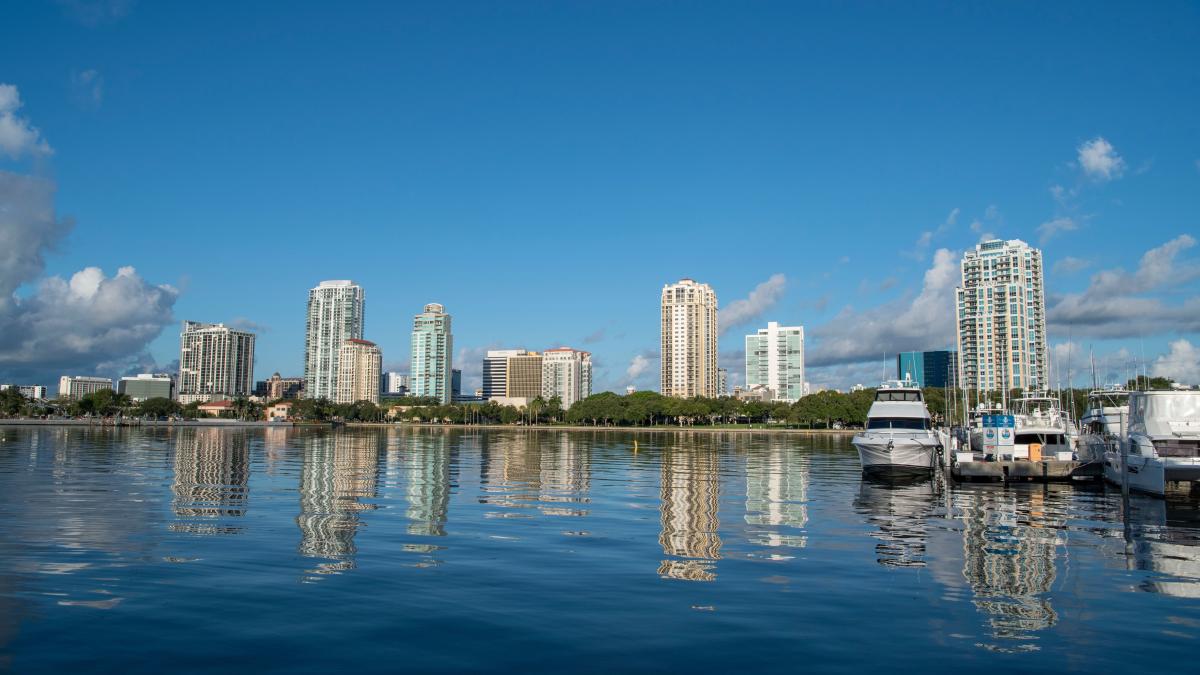
Commercial Roofing in St. Petersburg, FL
A practical commercial roofing plan for St. Petersburg, FL properties separates urgent leak control from repair, coating, maintenance, and replacement decisions supported by photos and condition findings. Commercial roof inspections, replacements, hurricane wind-uplift assemblies, and FBC HVHZ compliance work across St. Petersburg - Carillon Pkwy Class A office, downtown St. Pete, Pinellas Park industrial, Gateway corridor, and coastal exposure buildings.
St. Petersburg's Carillon Parkway Class A office concentration, downtown waterfront commercial, Pinellas Park industrial, and Gateway corridor logistics - all within our regular service routes from Downtown Tampa via the Howard Frankland Bridge.
St. Petersburg and Pinellas County represent the western anchor of Tampa Bay's commercial market - separated from Tampa by the bay but connected by the Howard Frankland and Sunshine Skyway bridges that put our crews in St. Pete within 25 to 35 minutes of our Downtown Tampa office in normal traffic conditions. The Pinellas County commercial roof inventory spans from the 1960s and 1970s downtown St. Pete commercial buildings undergoing redevelopment to the 1990s and 2000s Carillon Parkway Class A office cluster in the northeastern part of the county, the large-footprint Pinellas Park industrial corridor along 34th Street, and the Gateway corridor logistics and light-industrial inventory between I-275 and I-375.
Pinellas County's coastal exposure profile makes FBC HVHZ compliance and Miami-Dade NOA product approval requirements more uniformly applicable here than in most of Hillsborough County. The county is a peninsula surrounded by Tampa Bay to the east, the Gulf of Mexico to the west, and the Pinellas Bayway corridor to the south - buildings in the western coastal strip face direct Gulf exposure, and buildings along the Tampa Bay shoreline face surge exposure from both Gulf hurricane approach and Tampa Bay amplification. Hurricane Milton's 2024 track passed over Pinellas County producing storm surge along both the Gulf coast and the Tampa Bay eastern shore, with commercial building damage concentrated in areas where roofing assemblies had not been engineered to the coastal exposure wind loads.
Carillon Parkway Class A Office Concentration
The Carillon Parkway corridor in northeast St. Petersburg - rooted in Raymond James Financial's corporate campus and the surrounding Class A office cluster along Ulmerton Road and Dr. Martin Luther King Jr. Street N - is the primary Class A office concentration in Pinellas County. The Carillon buildings from the late 1980s through the early 2000s are in active first and second reroof cycles. Many of the roofs in this corridor were installed in the 2000 to 2010 window and are approaching or at end of original warranty life.
Carillon office buildings are subject to the standard FBC Pinellas County wind-speed requirements, with Exposure C applying to most of the corridor given its proximity to Tampa Bay's open-water fetch to the east. The design pressures for Carillon buildings are similar to Westshore Tampa: approximately -20 psf field, -40 to -45 psf perimeter, -60 to -70 psf corner for a typical two-story office building with parapets. Buildings in this corridor that have not had a fastener-pattern engineering review are candidates for the same perimeter and corner zone under-fastening issue that drove the post-Milton assessment work in Tampa.
Property management firms operating the Carillon portfolio - including Highwoods Properties and several institutional REIT owners - typically require documented condition assessment reports and FBC compliance documentation before authorizing major roof capital projects. We produce assessment reports that meet the format and content requirements of the major institutional property managers operating in this corridor.
Downtown St. Pete and the Waterfront Redevelopment District
Downtown St. Petersburg's commercial inventory has been in active redevelopment since the early 2010s, with the waterfront district along Beach Drive and the pier corridor seeing significant mixed-use and Class A office investment. The Mahaffey Theater block, the St. Pete Pier district, the historic Vinoy Hotel and surrounding commercial buildings, and the newer Class A office construction in the downtown core represent a range of building vintages with correspondingly different roofing scope challenges.
Historic commercial buildings in downtown St. Pete - particularly those along Central Avenue and Beach Drive in the historic commercial district - have the same masonry-specific flashing challenges as Ybor City in Tampa: brick-to-membrane transitions, irregular parapet profiles, and in some cases Florida Landmarks Commission review for alterations to historic building envelopes. We have direct experience with the City of St. Petersburg's Historic Preservation review process for roofing work on designated historic buildings.
The Pier District and Waterfront Park redevelopment along First Avenue South and Beach Drive is primarily new construction from 2018 through the present. These buildings are in first warranty maintenance cycles and require the documented annual inspection reports that keep manufacturer warranties active. Our maintenance contract format for downtown St. Pete waterfront properties includes salt-air corrosion monitoring of metal components as a specific line item, given the direct Gulf of Mexico and Tampa Bay air exposure at these locations.
Pinellas Park Industrial Corridor
Roof review
Get a written Tampa Bay commercial roof scope.
We document the roof condition, separate urgent repairs from capital work, and give ownership a practical path before money gets spent.