
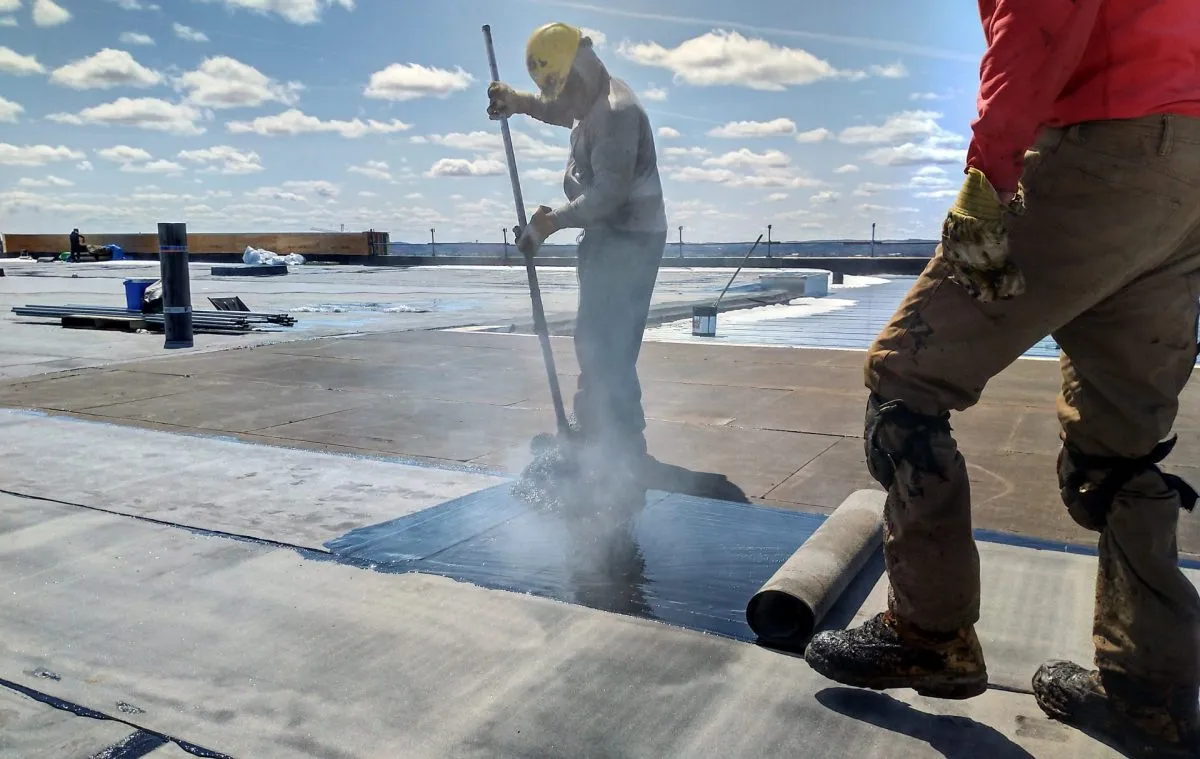
Built-Up Roofing (BUR)
Built-up roofing assessment, targeted repair, and full replacement for Tampa Bay commercial buildings - moisture core analysis, gravel flood coat evaluation, hot-applied BUR replacement with modified bitumen cap, FBC HVHZ documentation.
Tampa Bay's commercial inventory includes a significant stock of 1960s through 1990s built-up roofing systems that are in active replacement cycles. We assess existing BUR systems for insulation saturation and membrane condition, and specify replacement systems that meet current FBC HVHZ wind-uplift requirements.
Built-up roofing was the dominant commercial flat-roof system in Tampa Bay from the 1950s through the early 1990s. The TIA-adjacent industrial corridor, the downtown Tampa commercial core along Franklin Street and Kennedy Boulevard, the Ybor City commercial district, and Port Tampa Bay's older terminal and warehouse buildings all carry significant BUR inventory. Much of this stock is in active replacement cycles - the original systems are past their design life, and the insulation saturation that Tampa Bay's humid subtropical climate produces over decades of service has reduced R-values and is driving active leak issues that targeted repairs cannot economically resolve.
Assessing a BUR system accurately requires more than a visual roof walk. The multi-ply felt-and-bitumen membrane can appear intact from the surface while the insulation beneath it is heavily saturated - Tampa Bay's high ambient humidity and frequent summer rainfall mean that moisture that enters through minor membrane failures does not dry out between rain events. We pull moisture cores in a systematic grid pattern, typically five to ten cores on roofs we suspect have significant saturation, before recommending replacement versus repair versus recover.
Replacement of an existing BUR system today means replacing it with a modern single-ply membrane or modified bitumen system that meets current FBC HVHZ wind-uplift requirements and carries a Miami-Dade NOA product approval for the new assembly. The BUR itself is rarely the replacement material of choice in new work - modern modified bitumen cap sheets over a hot-applied bitumen base, or single-ply TPO or PVC in a fully adhered configuration, provide better wind-uplift performance, better manufacturer warranty terms, and lower installed cost than a conventional multi-ply BUR for most Tampa Bay commercial building applications.
Moisture Core Analysis and Saturation Assessment
Insulation saturation is the defining condition issue in aging Tampa Bay BUR systems. The typical stack is a concrete or metal deck with a vapor retarder, a base layer of perlite or fiberboard insulation installed hot in the original bitumen mop, and multiple plies of felt embedded in additional bitumen mop coats. Moisture infiltrates through surface cracks in the flood coat, through open laps, and through failed penetration flashings. Once moisture enters the insulation layer, the saturated perlite or fiberboard has essentially zero R-value and adds significant dead load to the deck.
We pull cores with a half-inch hole saw and weigh the core sample before and after oven drying to calculate the moisture content by weight. A core reading above 5 percent moisture content by weight is wet for insulation assessment purposes. We map core locations and results on the roof plan and present the moisture map to the building owner as the basis for the repair-versus-replace recommendation. If more than 20 to 25 percent of the roof area reads wet on core analysis, full replacement is the honest scope - recovering or recoating over wet insulation traps the moisture, produces thermal bridging through the wet zones, and delivers a failed new system within five to seven years.
For buildings in the downtown Tampa commercial core, Westshore, or other occupied commercial districts where a full replacement requires tenant notification and operational coordination, we sequence the core-pull assessment and condition report as a first phase before any replacement scope is committed. The condition report documents the moisture map, the deck condition at each core location, the estimated square footage of saturated insulation, and the replacement scope recommendation with a cost range. This gives the building owner the information needed to plan the capital project and communicate with tenants before commitment.
Flood Coat and Surface Condition Evaluation
The flood coat gravel surface of a BUR system is not just aesthetic - it protects the underlying felts from UV degradation, provides ballast against wind uplift, and moderates thermal cycling by reflecting some of the intense Tampa Bay summer solar loading. When the flood coat gravel has been displaced by storm events, foot traffic, or equipment installation, the exposed bitumen surface weathers rapidly in Tampa's climate. UV oxidation of exposed bitumen accelerates dramatically in the subtropical sun, producing surface alligatoring and crazing that opens pathways for water infiltration.
We evaluate flood coat coverage and condition as part of every BUR assessment. Buildings that show significant gravel displacement - typically visible as large areas of exposed black or gray oxidized bitumen - may be candidates for gravel re-embedding if the underlying membrane is intact, or for a modified bitumen cap sheet application over the existing membrane if the membrane condition supports it. The decision depends on the moisture core results: a BUR with good flood coat coverage and dry cores may support a cap sheet application as an economical life extension. A BUR with displaced flood coat and wet cores does not.
Surface ponding is a specific BUR condition issue on Tampa Bay commercial buildings with inadequate drainage. The city's afternoon thunderstorm season delivers intense rain rates - two to three inches per hour during peak convective events - that exceed the drainage capacity of undersized or partially blocked drain systems. Ponded water on a BUR accelerates flood coat gravel displacement through the water column weight, increases the static load on the deck, and creates the standing-water condition that drives membrane separation at seams and flashings. We document ponding locations on the roof plan and evaluate drain capacity as part of every BUR assessment.
Roof review
Get a written Tampa Bay commercial roof scope.
We document the roof condition, separate urgent repairs from capital work, and give ownership a practical path before money gets spent.