
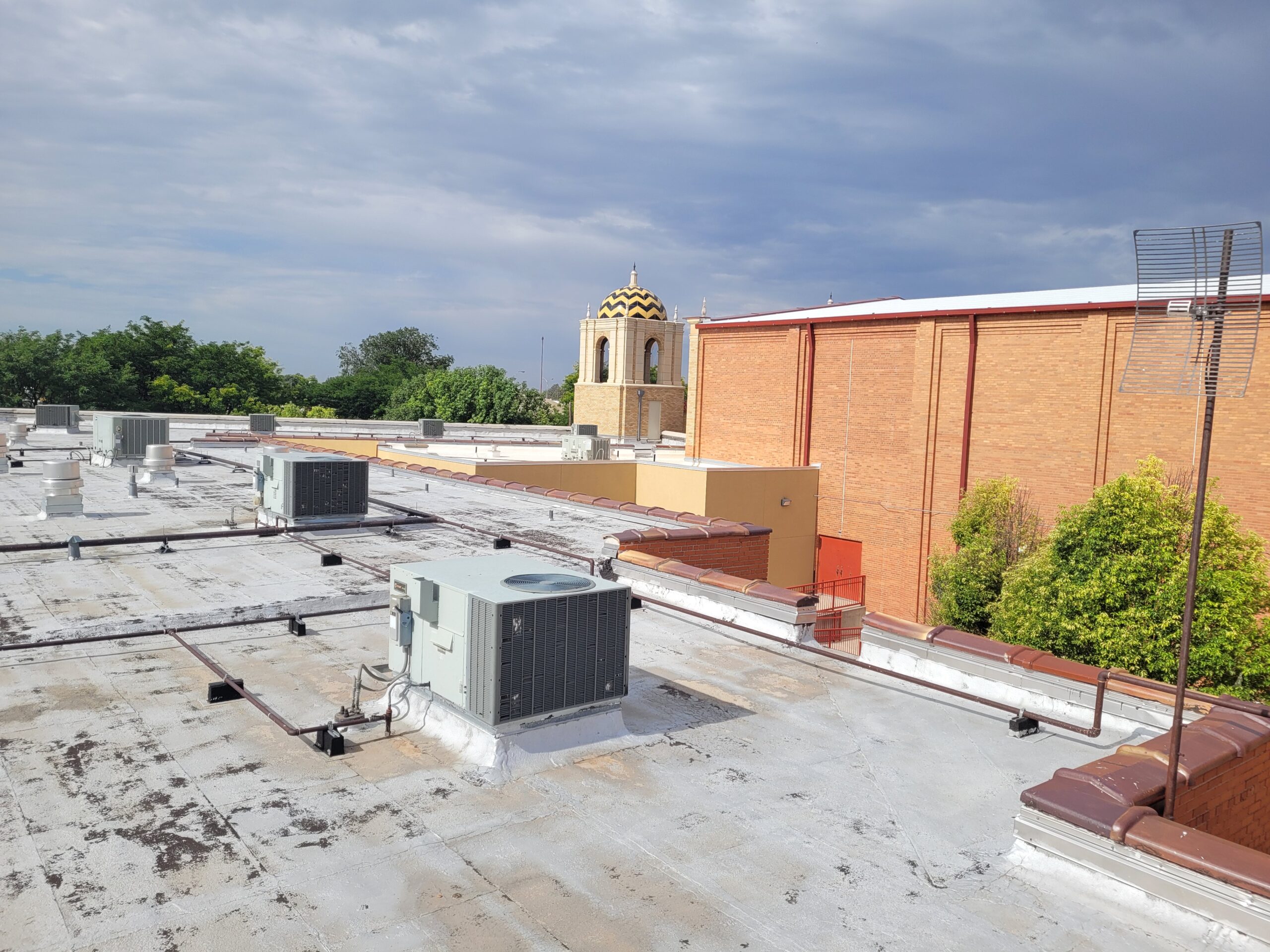
Capital Planning Support for Commercial Roofs
Roof capital planning support for Tampa Bay commercial building owners and managers - multi-year replacement cycle forecasting, FBC HVHZ compliance cost modeling, competitive bid support, and budget documentation for Hillsborough and Pinellas County portfolios.
A commercial roof capital plan converts the next replacement from a reactive emergency cost to a budgeted capital project. We produce the condition baseline, the replacement cycle forecast, and the competitive bid documentation that Tampa Bay commercial building owners and property managers need to plan roof capital over a five to fifteen year horizon.
Commercial roof capital planning in Tampa Bay has a specific set of inputs that other markets do not require. The FBC HVHZ compliance cost for coastal Hillsborough and Pinellas County buildings - the additional cost of NOA-approved assemblies, engineered fastener patterns, and Miami-Dade NOA documentation versus standard IBC-specification roofing - adds 15 to 25 percent to replacement project cost for comparable-scope work in a non-coastal Florida market. The post-hurricane acceleration of replacement cycles when storm events produce damage or deferred the maintenance that had been holding roofs together is a planning variable that national capital planning models do not capture for Tampa Bay conditions. And the Florida Energy Code R-value requirements for new insulation stacks on replacement projects have increased significantly since the early 2000s, meaning that buildings last replaced in that era will see a larger insulation cost component in their next replacement than their prior cycle cost would suggest.
The capital planning support we provide starts with a condition assessment that establishes the current baseline for each roof in the portfolio or single-building scope. From that baseline, we produce a replacement cycle forecast that projects the year in which each roof reaches the condition threshold for major capital intervention - replacement, recover, or extended-life coating. The forecast is presented with a range - not a single year - that reflects the condition uncertainty inherent in a projection from a point-in-time assessment. The range widens for roofs in marginal condition where the trajectory is sensitive to whether deferred maintenance interventions are executed on schedule.
We do not produce capital plans as a mechanism to generate replacement contracts. Capital plan clients who use our planning documentation to run competitive bids on their replacement projects - which is the correct process for institutional property owners and building owners with fiduciary obligations - get our support through the bid process as a defined scope item. We write the bid specification, review bids for technical completeness and FBC HVHZ compliance, and produce a bid comparison report that gives the building owner the information to make an informed award decision.
Condition Baseline and Replacement Cycle Forecasting
Every capital planning engagement starts with a documented condition assessment of each roof in scope. For portfolio engagements across Hillsborough and Pinellas County buildings, we conduct condition assessments on a compressed schedule - typically completing a ten to twenty building portfolio assessment in two to three weeks during the pre-thunderstorm-season spring window. The assessments follow a standardized protocol that produces comparable condition data across buildings so that the capital prioritization can be done against a consistent scale.
The replacement cycle forecast for each building projects three scenarios: a base case that assumes deferred maintenance interventions are completed as recommended, an accelerated case that assumes no maintenance interventions and normal Tampa Bay weather exposure, and a storm-impact case that applies the post-storm acceleration factor observed in the post-Milton assessment data from similar buildings in the portfolio's coastal exposure classification. The three scenarios bracket the realistic planning range for each building and give the building owner a defensible basis for both the optimistic and conservative capital budget.
For Tampa Bay buildings where the last replacement occurred in the 1990s or early 2000s, the capital plan includes a specific FBC HVHZ compliance cost analysis for the next replacement cycle. These buildings were last replaced under pre-NOA or early NOA enforcement standards, and the next replacement will be priced against current FBC HVHZ requirements - a meaningful additional cost component that is not captured in simple inflation-adjusted extrapolations from the prior cycle cost.
HVHZ Compliance Cost Modeling
The FBC HVHZ compliance cost premium for Tampa Bay coastal commercial roof replacement is a line item that capital plans in this market must carry explicitly. The premium has three components. First, the NOA-approved membrane assembly: NOA-approved products from the major manufacturers - GAF EverGuard TPO with Miami-Dade NOA, Carlisle SURE-WELD with NOA, Firestone RubberGard EPDM with NOA - are priced at a premium over the same manufacturers' non-NOA products. Second, the HVHZ fastener pattern engineering: tighter fastener patterns at perimeter and corner zones increase both material and labor cost. Third, the NOA documentation package: producing the compliance record required for permit submission and closeout adds professional time to the project cost that standard non-HVHZ projects do not carry.
We model HVHZ compliance cost as a range per square foot - the range reflects building-specific variables including coastal exposure classification (HVHZ coastal zone versus standard FBC inland), roof zone distribution (corner-heavy roofing with significant perimeter-to-field ratio increases the premium), and the specific NOA-approved assembly selected. For capital planning purposes, we present the HVHZ premium as a percentage range above the base replacement cost for comparable inland non-HVHZ buildings, so the building owner can benchmark against their inland portfolio properties.
Post-Milton insurer requirements have added an effective compliance cost premium beyond the direct installation cost: Tampa Bay coastal commercial buildings that cannot produce Miami-Dade NOA documentation from their last replacement are increasingly subject to insurance surcharges or coverage limitations that compound the cost of non-compliant roofing over the remaining service life of the system. We include a section in our capital plans for coastal buildings that quantifies the estimated insurer compliance requirement impact on the total cost of maintaining the existing non-compliant system versus replacing with an HVHZ-compliant assembly.
Roof review
Get a written Tampa Bay commercial roof scope.
We document the roof condition, separate urgent repairs from capital work, and give ownership a practical path before money gets spent.