
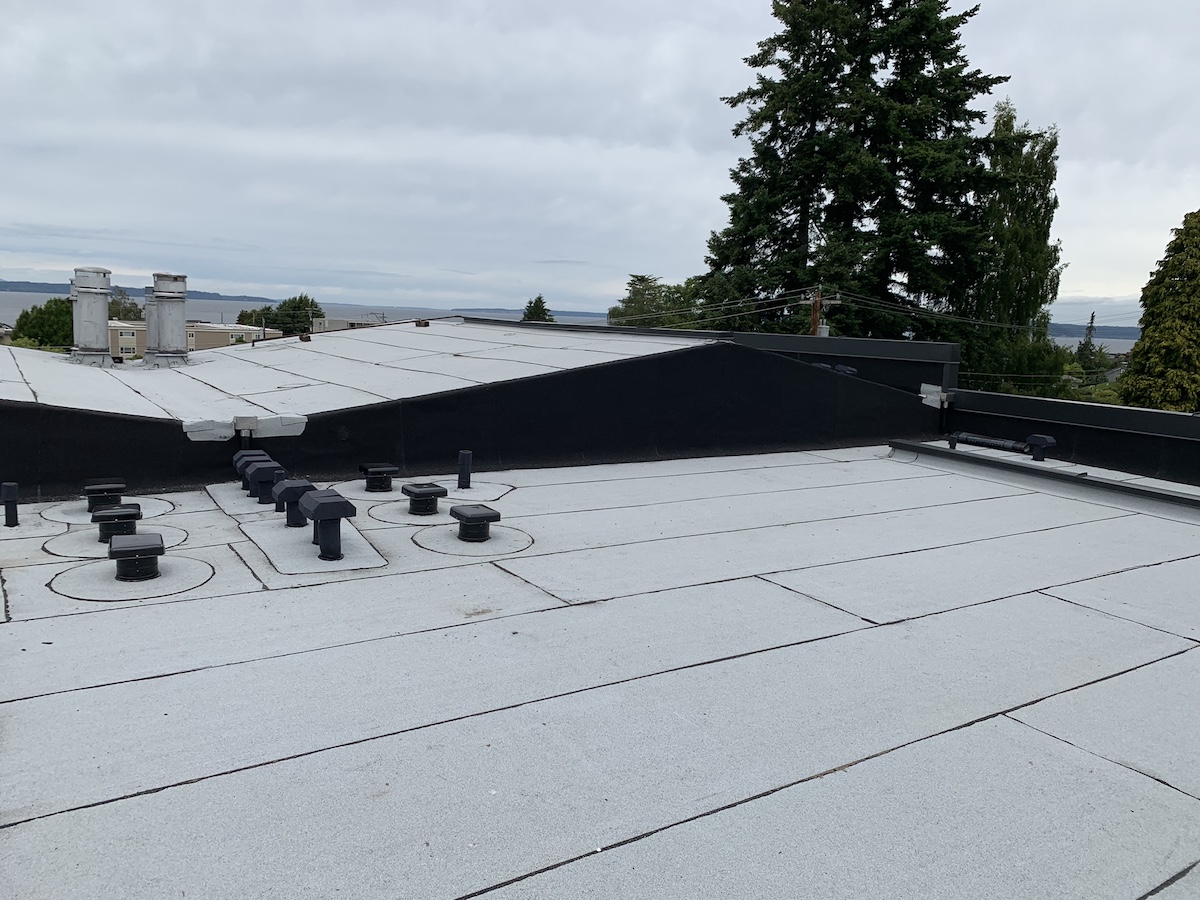
Modified Bitumen Roofing
Modified bitumen commercial roofing for Tampa Bay flat and low-slope buildings - SBS and APP systems with Miami-Dade NOA approval, FBC HVHZ compliance, torch-applied and cold-applied installation, and hurricane wind-uplift engineering.
Modified bitumen commercial roofing - SBS and APP systems - installed across the Tampa Bay metro with Miami-Dade NOA-approved assemblies, FBC HVHZ wind-uplift compliance, and installation protocols calibrated to Tampa Bay's subtropical heat, high humidity, and hurricane risk.
Modified bitumen roofing occupies a specific and durable position in the Tampa Bay commercial roofing market. The large inventory of 1980s and 1990s Tampa Bay commercial buildings - the Westshore office corridor buildout, the early TIA-adjacent industrial ring, the 1990s Brandon suburban commercial strip - was roofed predominantly in modified bitumen SBS (styrene-butadiene-styrene) systems that are now entering or past their original warranty life. Many of these systems are candidates for recover or replacement, and the building owners replacing them face a decision: return to modified bitumen with a new 20-year system, or transition to a single-ply TPO or EPDM system. Both paths are legitimate depending on the building, and we give you the honest comparison rather than defaulting to whichever system our current material contract favors.
Modified bitumen has two primary variants relevant to the Tampa Bay market. SBS-modified bitumen is a rubberized asphalt membrane that maintains flexibility at low temperatures and has documented puncture resistance superior to standard single-ply membranes - making it appropriate for buildings with heavy rooftop traffic from mechanical equipment maintenance. Tampa's healthcare campuses, the hotel properties in the Channelside and Water Street Tampa district with rooftop mechanical rooms, and the industrial buildings in the Port Tampa Bay logistics corridor with heavy HVAC and mechanical equipment footprints are appropriate modified bitumen candidates. APP (atactic polypropylene) modified bitumen is a harder membrane more UV-stable than SBS and appropriate for Tampa Bay's intense solar environment, but it is less flexible at the temperature extremes and less appropriate where puncture resistance from rooftop traffic is the primary concern.
Hurricane wind-uplift engineering for modified bitumen systems on Tampa Bay buildings requires the same HVHZ zone analysis as single-ply membrane systems, but the attachment methods are different. Heat-welded, torch-applied, and cold-applied adhesive assemblies each produce different uplift resistance values per the NOA testing, and the correct attachment method for each zone of the roof - field, perimeter, corner - depends on the NOA design pressure requirement for that zone on the specific building. We calculate the requirement and specify the method accordingly, rather than applying a uniform attachment across all zones.
SBS vs. APP Modified Bitumen for Tampa Bay Conditions
SBS modified bitumen is our specification for Tampa Bay buildings where rooftop mechanical equipment creates foot traffic loads that exceed the puncture resistance of standard 60-mil single-ply membranes. Healthcare campuses - Tampa General's Davis Islands campus, the BayCare system's Hillsborough County hospital facilities, USF Health - have dense rooftop mechanical equipment with maintenance access requirements year-round. SBS at two-ply application thickness produces a roof field with substantially higher puncture resistance than a 60-mil single-ply TPO or EPDM, and the two-ply lap system produces a seam redundancy that single-ply systems do not have.
SBS also performs well in Tampa Bay's temperature extremes. The Gulf Coast's occasional winter cold front - January temperatures in the 40s to low 50s Fahrenheit at roof level with wind chill - stresses single-ply membranes that are installed near their minimum temperature rating. SBS rubber-modified chemistry maintains flexibility at these temperatures without requiring a membrane that is over-specified for the Tampa Bay climate. The summer heat is the other extreme: rooftop temperatures on dark-surface modified bitumen roofs can reach 180 to 200 degrees Fahrenheit in Tampa Bay's summer, which is above the softening point of some APP formulations. We specify granulated-cap SBS systems or white-reflective APP for Tampa Bay installations where UV and thermal performance are the primary concerns.
APP torch-applied modified bitumen presents specific fire safety considerations in Tampa Bay urban settings. Torch application involves open flame on the roof, which requires coordination with the building occupants, notification of the City of Tampa Fire Marshal for occupied buildings, and a fire watch protocol during and after application. For Ybor City historic buildings and downtown Tampa commercial buildings in proximity to occupied adjacent structures, we evaluate cold-applied modified bitumen as an alternative that eliminates the open flame requirement without sacrificing system performance.
Miami-Dade NOA Assembly Compliance for Modified Bitumen
Modified bitumen systems for Tampa Bay HVHZ zone buildings must use NOA-approved assembly configurations. Modified bitumen NOA approvals are issued for specific combinations of base sheet attachment method, cap sheet attachment method, insulation type and thickness, and deck type - each combination carries a different tested design pressure. The NOA-approved assembly with the correct design pressure for the building's HVHZ zone exposure must be specified before any material selection is made.
For recover installations - modified bitumen cap sheet over an existing base sheet - the NOA approval must cover the recover configuration specifically. A cap sheet NOA approved for new construction over new insulation does not automatically apply to a recover installation over an existing base sheet on existing insulation. We verify the recover configuration against the available NOA approvals before specifying a recover scope and document the applicable NOA number in the specification.
Post-storm roof assessments on Tampa Bay commercial buildings after Hurricane Milton 2024 identified modified bitumen buildings where the cap sheet had experienced uplift-related blistering and delamination from the base sheet at perimeter and corner zones. This failure mode is specific to modified bitumen systems where the cap sheet attachment at perimeter zones used field mopping rather than the torch-applied or full-spread cold-adhesive method required for HVHZ zone perimeter design pressures. The failure confirms that attachment method - not just membrane type - must be zone-specific in HVHZ-compliant modified bitumen installations.
Roof review
Get a written Tampa Bay commercial roof scope.
We document the roof condition, separate urgent repairs from capital work, and give ownership a practical path before money gets spent.