
- Primary need:
Service - Roof record:
Written findings - Contact:
813-590-7975 - Office:
Downtown Tampa
Office Building Roofing
Commercial roofing for Class A, B, and C office buildings, suburban office parks, and downtown towers throughout Tampa, FL.
Amalie Energy's headquarters and the Class A tower complex that anchors Westshore Business District - Florida's largest suburban office market, with over 15 million square feet of Class A and Class B space along the I-275 corridor - represent the type of high-profile occupied office building roofing environment that defines professional commercial practice in the Tampa Bay region. Tampa's office market has absorbed billions of dollars of institutional investment over the past decade, and the landlords who own Westshore's Class A product maintain building envelopes at institutional quality standards that make roofing contractors accountable in ways that smaller markets do not.
Hillsborough County's design wind speeds - 130 to 145 mph depending on location - and Florida's Product Approval requirement create a high compliance bar for Tampa office building roofing. Fully adhered TPO is the dominant specification in Westshore's Class A market because institutional landlords and their lenders require systems that provide maximum wind uplift resistance and manufacturer-backed warranty coverage. Mechanically attached systems are used where budget constraints or existing deck conditions require them, but the leading institutional property managers in the Tampa market - Cushman and Wakefield, JLL, and CBRE - have established standard specifications that default to fully adhered systems on Class A assets.
Tampa's summer thunderstorm season - the most intense convective rainfall in the continental United States - creates occupied building protocol demands that are unique to the Gulf Coast. An afternoon thunderstorm that dumps two inches in 30 minutes can overwhelm any open work area on an office building roof that isn't immediately watertight. We staff Tampa office roofing projects with a designated weather watch who monitors local radar and National Weather Service alerts continuously from 11 a.m. through 4 p.m. daily during thunderstorm season. When the radar shows a developing storm within 30 minutes of the site, we begin securing open areas immediately - before the crew would naturally call it based on visual observation. This weather watch protocol has prevented hundreds of interior water damage events on Tampa office projects over the years we've operated in this market.
Florida Building Code energy requirements apply to Tampa office building re-roofing, requiring cool-roof membrane specifications and insulation R-values appropriate for Climate Zone 2A. White TPO with a Solar Reflectance Index of 100 or higher reduces peak summer cooling loads on a Tampa office building - where air conditioning runs essentially year-round - in a climate where cooling accounts for 40 to 50 percent of the building's total energy cost. Energy modeling for a 100,000-square-foot Westshore Class A building shows annual cooling cost savings of $15,000 to $25,000 from switching from a dark membrane to white TPO. Over a 20-year warranty period, those savings significantly exceed the cost premium for the reflective specification.
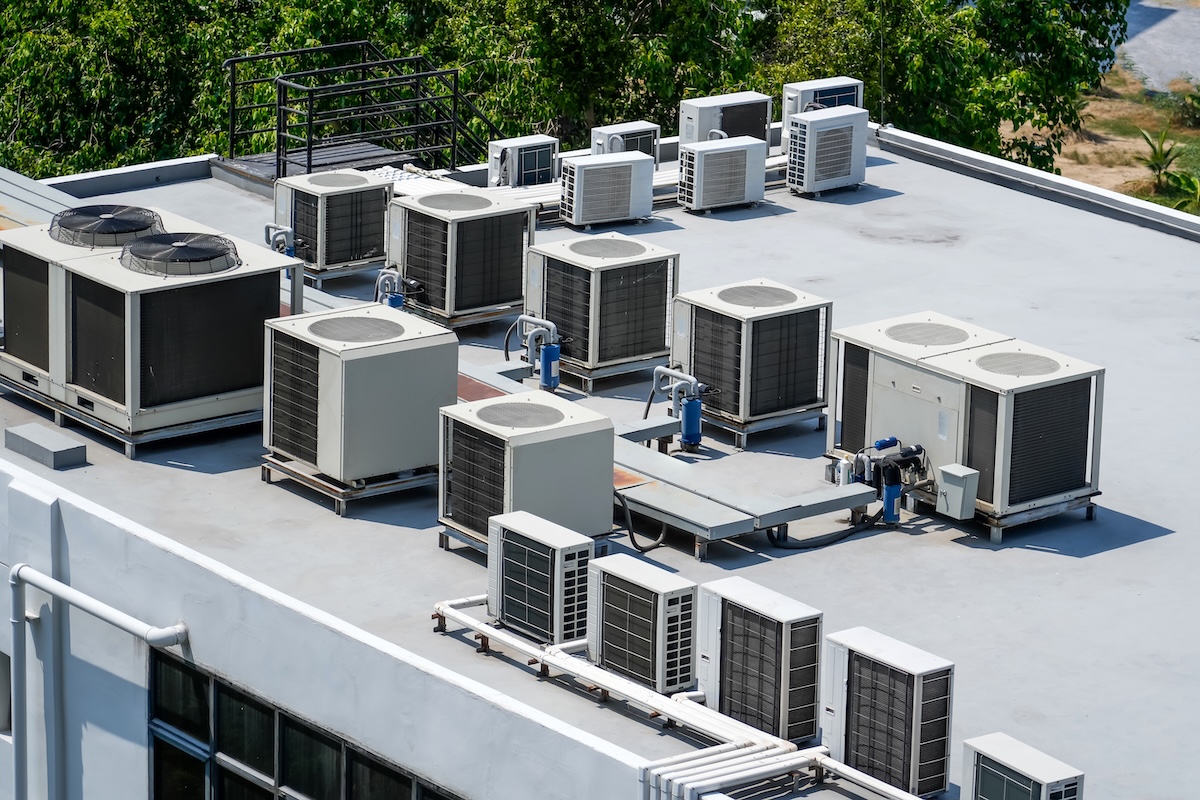
HVAC coordination on a Tampa Class A office building is the most complex logistical element of a re-roofing project. Westshore's large office buildings use sophisticated multi-zone HVAC systems with rooftop equipment ranging from small package units above individual floor sections to large chilled water cooling towers that serve the entire building. Any unit relocation requires coordination with the building's mechanical contractor, building automation system programmer, and the tenant's facilities team if tenant-supplied supplemental cooling units are involved. We develop a detailed HVAC coordination matrix before work begins that maps every piece of rooftop equipment to its electrical, plumbing, and ductwork connections and assigns a specific relocation sequence and backup plan to each one.
LEED certification and energy efficiency documentation are valued by Tampa's institutional office market. Buildings in the Westshore district and along the downtown Tampa waterfront have pursued ENERGY STAR and LEED certifications as competitive differentiators, and re-roofing projects are opportunities to contribute credits. Cool-roof surface compliance, construction waste diversion, low-VOC adhesives, and insulation recycled content can all contribute to LEED credits on an occupied building certification submission. We document all potential credit contributions during the project and provide credit documentation forms at closeout for buildings pursuing formal certification or recertification.
Lease obligations in Tampa's institutional Class A market are rigorously enforced by sophisticated tenants. National law firms, financial services companies, and major healthcare systems that occupy Westshore and downtown Tampa's premium office space have large, professional in-house real estate teams who monitor lease compliance closely. Landlord maintenance obligations in Tampa Class A leases typically include specific requirements for roof maintenance frequency, response time for reported leaks, and in some cases specific technical standards for the roof system. Before beginning a re-roofing project on a Tampa Class A building, we review the tenant lease provisions with the property manager to confirm that the project approach, schedule, and documentation satisfy lease obligations.
Hurricane preparedness for a Tampa Bay area Class A office building has been elevated to a new level of seriousness following Hurricane Ian's 2022 near-miss of the metro. The near-hurricane that made landfall at Fort Myers instead of Tampa - a track that many models predicted would hit Tampa Bay directly - has prompted major landlords and their insurers to re-examine building preparedness standards. Pre-storm roof preparation, documented annual maintenance, and the ability to demonstrate that the roof system has current Product Approval compliance are all factors that affect insurance premium pricing and claims adjustment following a storm event. We provide annual compliance reports to Tampa Class A building owners that document Product Approval status for all installed roof system components.
The Tampa Bay region's rapidly growing tech economy has brought new Class A office tenants with sustainability commitments that extend to the buildings they occupy. Amazon, Microsoft, and several large technology firms that have established significant Bay Area operations have their own internal building performance standards that include roofing specification requirements. When a technology tenant with published sustainability goals occupies space in a Tampa building undergoing re-roofing, we coordinate with the tenant's facilities team to ensure the roof specification meets their standards - which typically include cool-roof compliance, low-VOC adhesives, insulation recycled content documentation, and installation-waste diversion percentages.
Frequently asked questions
How do I know if my Tampa commercial building's BUR system needs replacement or repair?