
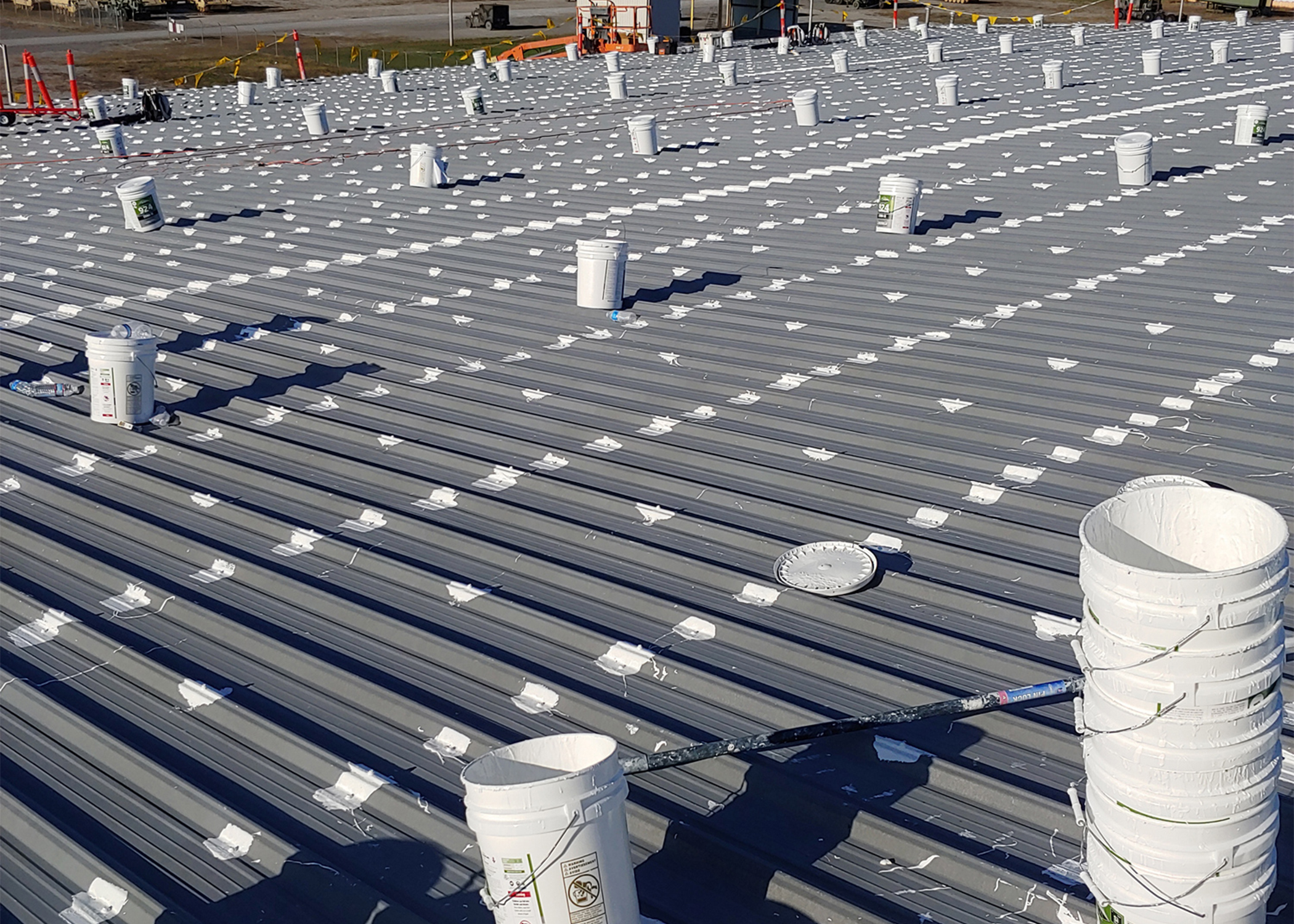
Silicone Roof Coating
Silicone roof coating application for eligible Tampa Bay commercial flat roofs - moisture core verification before coating, wind-uplift compatibility assessment, FBC compliance documentation, and manufacturer warranty alignment.
Silicone coating extends the service life of eligible commercial flat roofs in Tampa Bay - but only when the existing membrane is dry, the attachment is still wind-uplift competent, and the coating system carries a manufacturer warranty path. We verify all three before coating anything.
Silicone roof coating has a legitimate place in the Tampa Bay commercial roofing market, and it is a narrower place than the coating contractors who solicit commercial building owners by mail tend to describe. The eligible candidate is a commercial flat or low-slope roof that has a single-ply TPO, EPDM, or PVC membrane that is structurally sound, has dry insulation confirmed by moisture core analysis, and has a fastener attachment pattern that still meets the building's required wind-uplift design pressure. When all three of those conditions are true, a silicone coating system can deliver ten to fifteen additional years of service life at a fraction of the cost of full membrane replacement.
The ineligible candidate - and this is the majority of roofs that coating contractors solicit - is a membrane with wet insulation beneath it, a membrane with widespread seam delamination that the coating covers but does not repair, or a membrane whose fastener attachment has degraded to the point where it no longer meets the building's FBC HVHZ wind-uplift requirement. Coating over a wet substrate traps the moisture permanently, voids the new coating warranty on day one, and produces the same leak pattern within three to five years as the original membrane would have produced. Coating over an under-fastened membrane does nothing to restore wind-uplift performance - the coating has no load-path contribution to fastener attachment.
Our protocol for every coating engagement starts with the same assessment we perform for replacement - a roof walk, moisture core pull in a systematic grid, fastener pattern verification at perimeter and corner zones, and seam and flashing condition documentation. If the building is in Tampa Bay's coastal HVHZ exposure zone, we also verify that the existing membrane carries a Miami-Dade NOA product approval and that the coating system we propose has an NOA approval for application over the existing assembly. A coating applied to a membrane without the required NOA in the coastal zone creates a code compliance issue independent of the coating's technical performance.
Moisture Core Verification - Non-Negotiable Before Coating
We pull moisture cores before every coating application on Tampa Bay commercial roofs. Tampa Bay's subtropical climate - 47 inches of annual rainfall, most of it between June and September, with high ambient humidity that prevents insulation drying between rain events - produces insulation saturation in commercial flat roofs at a rate that makes core verification essential rather than optional. A membrane that looks clean and intact from the surface may have wet insulation under 20 percent or more of its area, driven by slow seam infiltration over years that the building's leak history did not capture because the moisture was not reaching the interior.
Core locations are selected to sample the perimeter zones, field zones, and areas near penetrations and drains - the locations where moisture infiltration statistically concentrates. We pull a minimum of one core per 2,000 square feet of roof area on coating candidate assessments, with additional cores near any area that shows surface blistering, soft spots underfoot, or ponding history. A core that comes out wet rules out coating for that zone - the zone requires either local replacement down to dry insulation or full replacement if the wet area exceeds the threshold where local replacement is economical.
Building owners are sometimes told by coating contractors that silicone coating will seal the wet insulation and stop the problem. That is not accurate. Silicone coating is a vapor-permeable membrane - it slows water transmission but does not reverse insulation saturation. Wet insulation coated with silicone remains wet, continues to lose R-value, and continues to drive slow membrane separation from below. The coating may delay the surface leak signature, but it does not remediate the underlying condition.
Wind-Uplift Compatibility in the HVHZ Zone
Tampa Bay coastal commercial buildings in the FBC HVHZ exposure zone present a specific coating compatibility issue that inland coating projects do not face. A silicone coating applied over an existing mechanically attached TPO membrane adds weight and changes the surface characteristics of the assembly. The question is whether the coated assembly still meets the required design pressure for the building's coastal exposure zone under the existing fastener pattern.
We calculate the existing membrane's wind-uplift design pressure based on the fastener count per linear foot in each zone. If the existing membrane was installed with the correct NOA-compliant fastener pattern for its HVHZ exposure classification, and if the coating system has an NOA approval for application over the specific membrane type, the coated assembly is code-compliant and the calculation stands. If the existing membrane was installed without HVHZ-compliant fastener engineering - which is common in the pre-2010 commercial building stock - the coating does not correct the deficiency. We document this condition in the assessment report and present both the coating-with-re-fastening scope and the full replacement scope for the building owner's decision.
For buildings where re-fastening to HVHZ-compliant densities is required before coating is code-compliant, the re-fastening scope adds material and labor cost that may reduce or eliminate the cost advantage of coating over full replacement. We present both options with cost ranges so the building owner can make an informed capital decision.
Roof review
Get a written Tampa Bay commercial roof scope.
We document the roof condition, separate urgent repairs from capital work, and give ownership a practical path before money gets spent.