
Commercial Solar Roof Integration
Roof-first solar integration for Tampa commercial buildings - PV racking penetrations, membrane compatibility, weight and hurricane uplift checks, and warranty coordination between your roofer and solar installer.
Solar developers sell panels. We are the crew that has to make sure the membrane under those panels survives the next twenty-five years, and that is a different conversation entirely. A rooftop array is a roofing project wearing an electrical hat: every racking foot, every conduit run, and every pound of ballast lands on a surface we are responsible for keeping watertight. We work on the flat low-slope roofs that define commercial Tampa, from the office towers along the Westshore Business District and Boy Scout Boulevard to the distribution buildings feeding Port Tampa Bay off Adamo Drive, and the array gets penciled into the financials long before anyone asks whether the roof can actually host it.
The roof has to be evaluated before the array is designed
Put a system with a twenty-five-year production life on a membrane that has six or seven years left, and you have bought yourself a very expensive problem. When that membrane fails, the entire array has to be detached, the racking and ballast removed, the roof replaced, and the panels reset and re-commissioned. That detach-and-reset cost shows up nowhere in the original solar proposal, and it strands the owner between a leaking roof and a solar contract. So the first thing we deliver on any Tampa solar job is a straight answer on remaining membrane life. If the roof is near the end, the economical move is almost always to re-roof first and set the array on a new system so both service lives expire together. If the membrane is young and tight, we document that it can carry the array and move forward.
Penetrations and racking are roofing details first
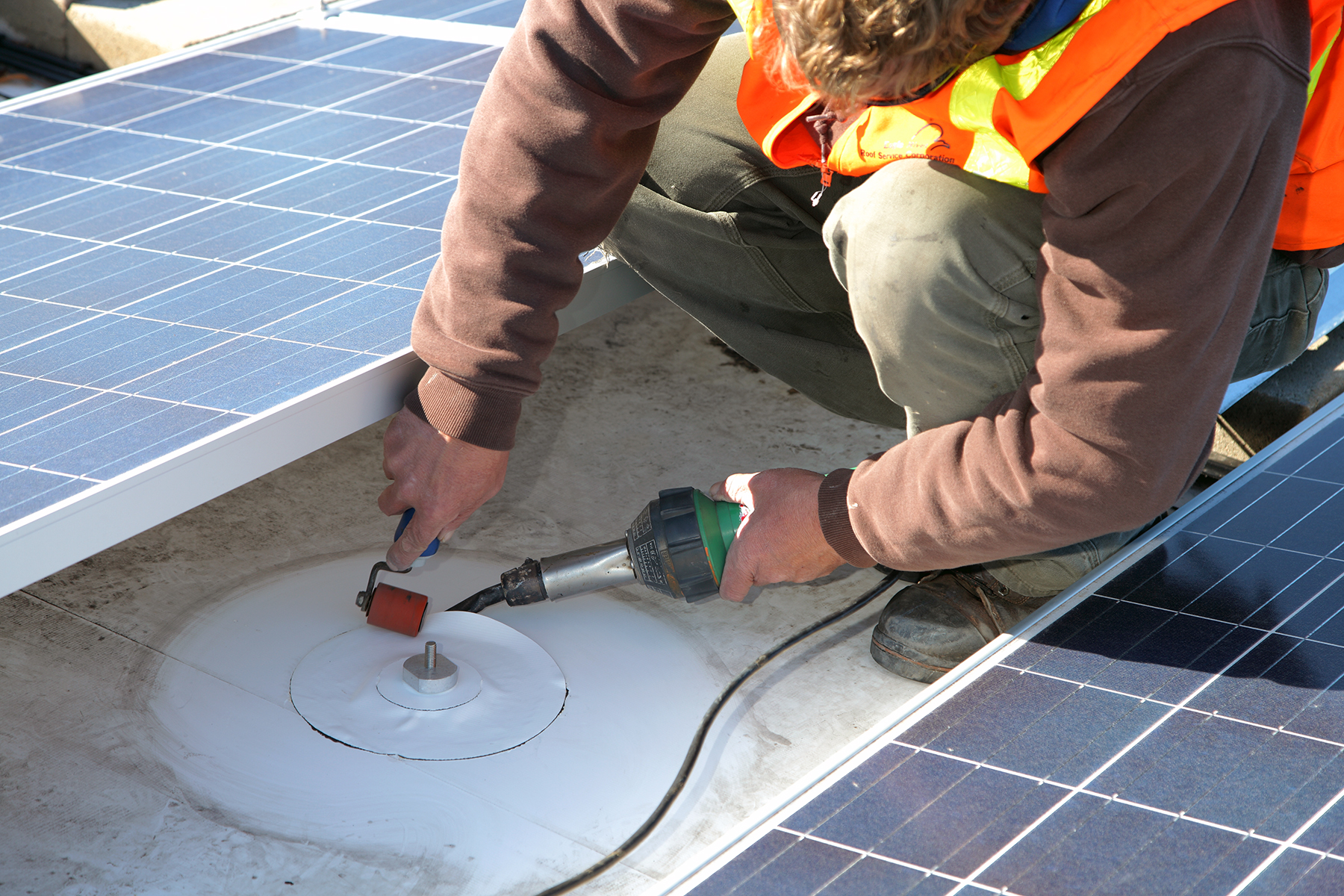
There are two ways to hold an array down on a low-slope roof, and each one is our problem before it is the electrician's. Mechanically attached racking drives a stanchion and fastener through the membrane at regular spacing, and every one of those is a penetration that has to be flashed to the membrane manufacturer's published detail - not capped with a generic sealant pocket that crazes and splits after two Florida summers. Ballasted racking skips the penetrations and holds the array with weighted trays instead, trading the leak exposure for a load and uplift problem. On a Tampa roof both have to be modeled against wind, because this is a hurricane-zone jurisdiction governed by the high-velocity wind provisions of the Florida Building Code. The attachment density and any ballast layout have to be engineered for the design wind pressures at that building's specific height and exposure, never borrowed from a project in a calmer market.
Membrane compatibility and rooftop traffic
The membrane itself decides a lot about what can sit on it. A reflective TPO or PVC surface runs cooler, which is good for both the roof and the panel backs in our heat, but the sheet chemistry still has to be compatible with the racking feet, the protection pads, and any conduit supports bearing on it. We specify slip sheets and protection pads at every contact point so the hardware cannot abrade or chemically attack the membrane underneath. We also lay out dedicated walkways to the array, the inverters, and the combiner boxes - because the day solar goes up, that roof gains foot traffic for the life of the system, and unprotected traffic at the panel rows is exactly how a sound membrane gets ground through.
Weight, uplift, and what the structure can carry
A lot of Tampa's commercial building stock was never designed with rooftop solar in mind - the mid-century buildings around the Channel District and Ybor City edges, the second-generation industrial along Hillsborough Avenue. Before a ballasted layout gets specified, the added dead load per square foot has to be checked against the deck and framing capacity, and that is a structural engineer's determination, not a roofer's eyeball. We raise it early so the project team brings the right engineer in before the design is frozen. Uplift is the other half of the problem: panels behave like sails, and the corner and perimeter zones of a roof see the highest wind pressures, so racking density and attachment almost always have to step up in those zones. Getting that wrong does not just void a warranty - it puts panels in the parking lot after the first real storm.
Coordinating two warranties so neither one breaks
The quietest way a solar project destroys value is by voiding the roof membrane warranty. Most major membrane manufacturers will permit an array on a warranted roof, but only when the penetration details, protection layers, and attachment method follow their published requirements and the manufacturer reviews the installation. We arrange that review up front, so the manufacturer signs off on the array detailing before panels are set rather than walking the finished roof and disclaiming coverage. We also draw a hard line between scopes: the roofing contractor owns the membrane, the flashings, and every penetration through the deck; the solar EPC owns the panels, racking, and electrical. Conduit penetrations specifically get flashed by us, not boot-sealed by the solar electrician, because those rubber boots are a predictable leak within a few seasons.
How we sequence a combined roof-and-solar job
Roof review
Get a written Tampa Bay commercial roof scope.
We document the roof condition, separate urgent repairs from capital work, and give ownership a practical path before money gets spent.