Standing-Seam Metal Roofing
Standing-seam metal roofing installation and re-cover for Tampa Bay commercial buildings - Galvalume steel and aluminum panel systems with FBC HVHZ clip-attachment engineering, Miami-Dade NOA assembly documentation, and coastal salt-air material specification.
Concealed-fastener standing-seam metal panels designed for Tampa Bay's Gulf Coast wind loads and salt-air exposure - engineered to FBC HVHZ clip-attachment requirements and closed out with Miami-Dade NOA documentation and manufacturer warranty.
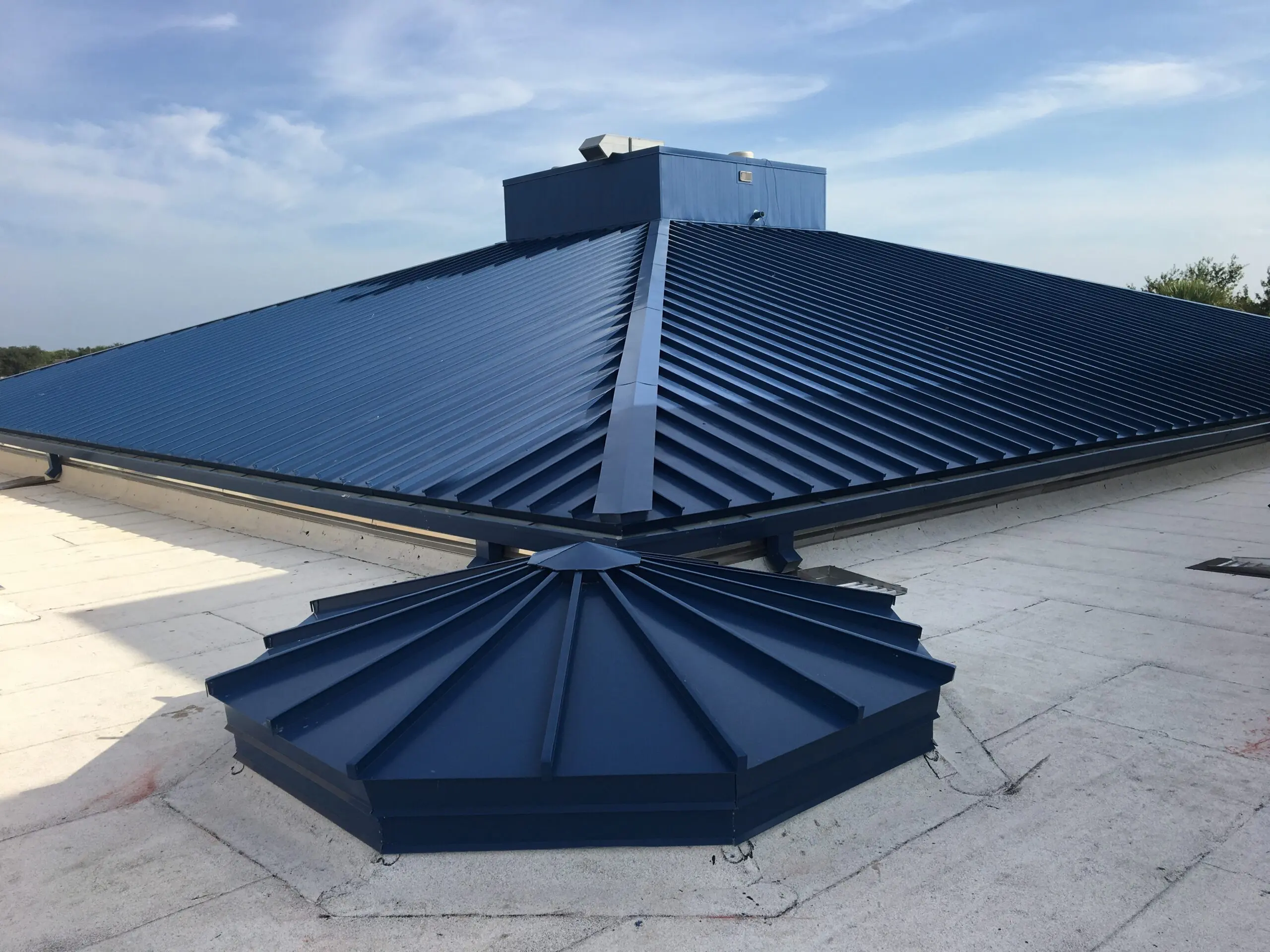
Standing-seam metal roofing earns its place on Tampa Bay commercial buildings for specific reasons that have nothing to do with aesthetics. The concealed-fastener system eliminates the primary failure point of exposed-fastener metal roofing - the gasketted screw that cycles under thermal movement and eventually pulls through or wicks water - and replaces it with a clip attachment that allows the panel to float with thermal expansion while maintaining continuous contact with the structural support. On a Tampa Bay building that sees 100-degree roof-surface temperatures in July and 55-degree mornings in January, that thermal float range is significant. Exposed-fastener metal roofing in this climate performs poorly past fifteen years. Standing-seam, properly installed and maintained, routinely reaches forty to fifty years on commercial buildings.
The other Tampa Bay-specific reason is wind-uplift performance. Standing-seam metal panels with concealed clips can achieve design pressure ratings that exceed what single-ply membrane systems can reach at equivalent installed cost, particularly at perimeter and corner zones where the Florida Building Code HVHZ provisions require the highest design pressures. When we calculate the required design pressure for a Tampa Bay coastal commercial building against the FBC 2023 wind speed map and find that the corner zone requirement exceeds what a 60-mil TPO mechanically attached system can deliver without an unrealistic fastener density, standing-seam metal is often the solution that gets to the required design pressure without a cost premium.
Salt-air material specification is the third Tampa Bay-specific factor. Not all standing-seam metal is equivalent in a coastal environment. Galvalume-coated steel has a strong track record in Tampa Bay conditions at distances of two miles or more from saltwater exposure. Within one mile of Tampa Bay or the Gulf, aluminum panel systems or Galvalume with a heavy Kynar PVDF coating provide the corrosion resistance the environment demands. The clip attachment system, the fasteners that secure the clips to the structure, and the ridge cap and eave trim all need to be specified in corrosion-resistant materials for coastal exposure projects. Buildings that received standard Galvalume panels with galvanized clip systems installed within a mile of the Bay in the 1990s or early 2000s are showing clip and fastener corrosion that compromises the wind-uplift performance of the panel attachment.
FBC HVHZ Clip Engineering and Miami-Dade NOA Approval
Standing-seam metal systems installed on Tampa Bay coastal commercial buildings require Miami-Dade NOA product approvals for the specific panel-and-clip assembly. The NOA for a standing-seam system specifies the panel profile, the clip type, the clip spacing, the fastener size and grade, and the structural support spacing. Deviating from any of these parameters means the NOA does not apply to the installed assembly - the warranty is void and the building fails code.
Clip spacing is the engineering variable with the most impact on design pressure performance. Standard clip spacing for a standing-seam system on a low-wind-exposure building is typically 60 to 72 inches on center. On Tampa Bay HVHZ coastal buildings, the corner zone clip spacing in an NOA-approved system may be reduced to 12 to 18 inches on center to achieve the required design pressure - a change that significantly increases material and labor cost for the corner zones and must be reflected in the project specification and close-out documentation.
We document the NOA number, the clip spacing used in each zone, and the relationship between the installed clip spacing and the NOA design pressure for each roof zone in the project specification and closeout package. For Westshore office buildings and Port Tampa Bay industrial facilities where the building owner's insurer or property manager requires documented FBC HVHZ compliance, this documentation is what backs up the coverage.
Tampa Bay Applications - Where Standing-Seam Makes Sense
Standing-seam metal is not the right choice for every Tampa Bay commercial building. It performs best on roofs with a slope of at least 1:12 - on a truly flat membrane-roof application, the slope requirement alone rules it out for most multi-story commercial buildings. Where it fits are sloped warehouse and distribution center roofs along the TIA-adjacent industrial corridor, metal-clad office and flex buildings in the Brandon and Riverview suburban commercial growth areas, and specialty buildings like Tampa Electric substations, Tampa Port Authority infrastructure buildings, and outdoor venue structures in the Ybor City and Channel District entertainment corridor.
Re-roofing from an aging exposed-fastener metal system to standing-seam is a common scope in the Tampa Bay suburban industrial market. The Seffner and Brandon warehouse corridors along I-4 include a significant inventory of 1980s and 1990s light-industrial buildings with original R-panel or 5-V crimp exposed-fastener metal roofing. These systems are at or past their useful life and are experiencing widespread fastener-pullthrough and seam-opening leaks. The correct scope is a standing-seam re-cover rather than a second coat of sealant on a failing exposed-fastener system - the re-cover delivers a concealed-fastener system with a forty-year profile on an existing structure without the cost of a full tear-off.
Hillsborough County agricultural and agro-industrial buildings in the Plant City and eastern Hillsborough County corridor are another standing-seam application. Packing house and cold-storage facilities, greenhouse support buildings, and rural commercial structures in this corridor benefit from the long service life and low maintenance demand of standing-seam metal, particularly where annual roof maintenance scheduling is challenging because of harvest-season operational demands.
Roof review
Get a written Tampa Bay commercial roof scope.
We document the roof condition, separate urgent repairs from capital work, and give ownership a practical path before money gets spent.