
Commercial Water Damage Roof Repair Tampa
Commercial water damage roof repair in Tampa - insulation saturation remediation, deck corrosion assessment, moisture mapping, drainage correction, and chronic ponding repair for Hillsborough County commercial flat roofs.
Water damage on a Tampa commercial flat roof is not a single event - it is a progression. What starts as a small membrane breach or blocked drain becomes a saturated insulation section, then deck corrosion, then structural deflection that creates new ponding zones, then additional leaks that extend the damage area further. We stop the progression at the earliest stage we find it.
Tampa Bay's subtropical climate creates water damage conditions on commercial flat roofs that do not exist in the same form in other markets. The summer wet season delivers rainfall at intensities that can produce two inches in an hour, challenging drain capacity on roofs that were designed to code-minimum drainage standards. The high ambient humidity between June and September prevents wet insulation from drying naturally - once insulation in a Tampa Bay commercial roof becomes saturated, it stays saturated because the daily humidity prevents the differential that would allow moisture to exit through the membrane surface. And the region's salt-air environment accelerates the corrosion of metal deck components that have been wetted by migrating roof moisture.
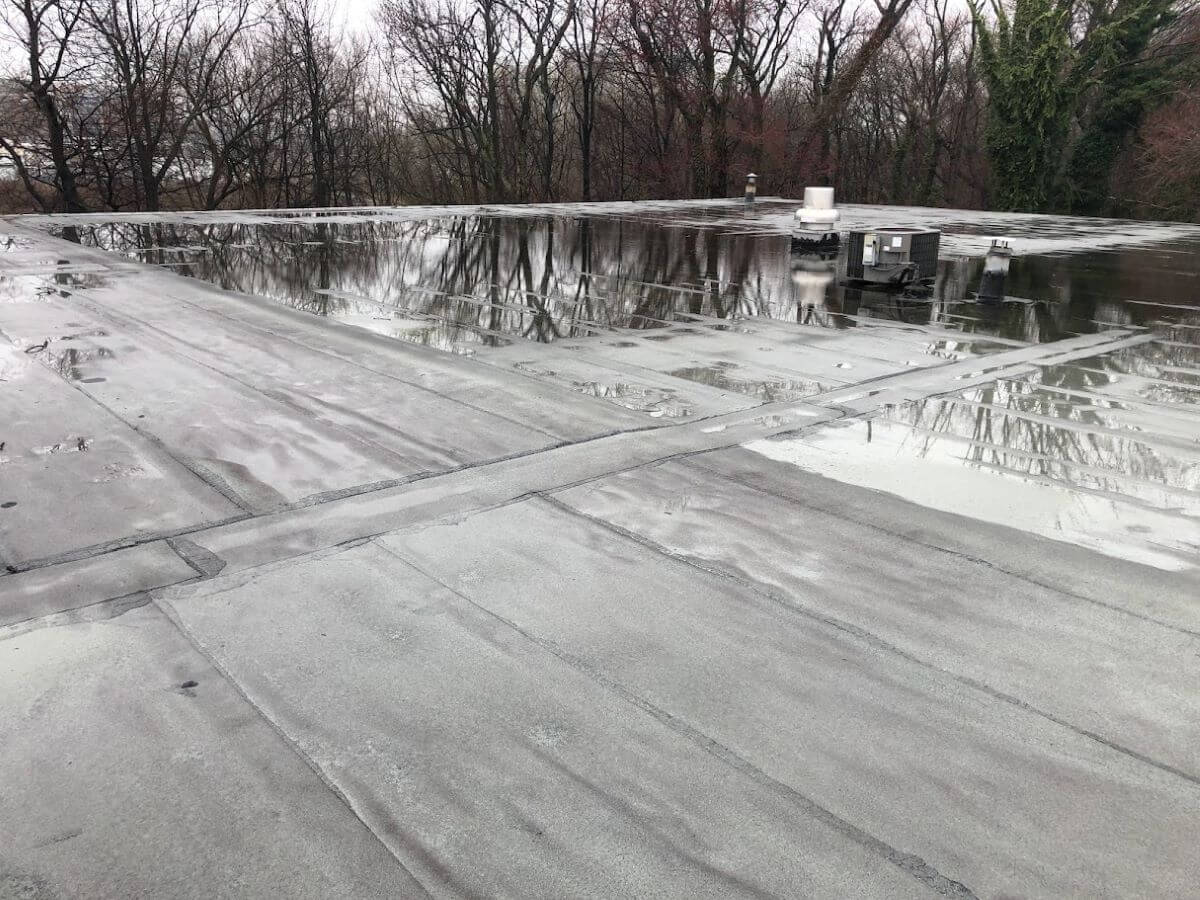
Chronic ponding is Tampa Bay's most underappreciated water damage mechanism. Flat roofs that pond more than two inches of water for more than 48 hours after a rain event are by definition deficient in drainage - either the drain system is undersized, the drain is blocked, the slope-to-drain is inadequate, or the roof has deflected enough to create a low spot that the original drainage design did not account for. Ponding water adds 12.5 pounds per square foot per inch of depth to the roof structure - a roof with six inches of ponding is carrying 75 psf in the ponding zone, which exceeds the live load design of most commercial flat roof structures.
We assess water damage on Tampa Bay commercial roofs as a system problem, not a single-component problem. The water entry point, the drainage configuration, the insulation moisture content, the deck condition, the roof slope-to-drain pattern, and the structural response all interact to produce the damage pattern we find. The repair scope addresses the system, not just the visible surface evidence.
Moisture Mapping and Insulation Saturation Assessment
Insulation saturation is the hidden cost of water damage on Tampa Bay commercial flat roofs. A commercial roof that leaks at one location deposits water into the insulation, which then transmits it horizontally in the direction of the slope-to-drain until it finds an exit - either a floor penetration, a drain bowl, or, over time, the deck surface. The area of saturated insulation is almost always larger than the leak-affected ceiling area on the floor below, and frequently extends to insulation that is remote from any visible leak evidence.
We use a combination of infrared thermal scanning and physical core sampling to map insulation moisture content across the affected roof area. The infrared scan identifies the distribution pattern of wet versus dry insulation based on the differential heat retention of wet and dry insulation in the evening cooling cycle - Tampa Bay's relatively warm nights require careful calibration of the thermal contrast threshold. Physical cores at locations identified by the infrared scan confirm the wet/dry classification and provide a moisture content reading from a moisture meter inserted into the core.
The moisture map drives the repair scope decision: how much of the insulation needs to be removed and replaced, and whether the deck below the wet sections needs to be assessed for corrosion damage. For Tampa Bay commercial buildings where the moisture content map shows more than 25 percent of the roof area with saturated insulation, recover options are eliminated - recovering wet insulation produces a void warranty, traps the moisture permanently, and typically produces the same leak pattern within three to five years.
Deck Corrosion from Chronic Moisture - Tampa Bay's Hidden Structural Risk
Metal deck corrosion from chronic roof moisture is a structural concern that roofing repair does not fully address on its own. Commercial flat roofs in Tampa Bay that have experienced years of insulation saturation - common on 1980s and 1990s buildings in the Westshore corridor, the Dale Mabry commercial strip, and the TIA industrial ring that are on original or first-recover roofing systems - frequently show evidence of deck corrosion at the top flange when the saturated insulation above them is removed during repair.
The corrosion pattern is typically concentrated at the top flange of the deck flutes directly below the areas of highest insulation saturation - which is the flattest section of the roof, where water pools in the insulation rather than draining. Surface rust on the deck top flange is a finding that we document and monitor but that does not typically require structural repair. Corrosion that has progressed to section loss - visible pitting, rust-through at the flange, or structural deformation - requires structural engineer review before the repair scope can proceed.
For Tampa Bay buildings in the coastal salt-air zone - within two to three miles of Tampa Bay or the Gulf - deck corrosion from chronic moisture is accelerated by the chloride environment. The combination of sustained wet insulation above and salt-laden air infiltrating the underside of the deck from the building interior creates a corrosion environment that can reduce deck section thickness at a rate that exceeds the allowable loss in the deck's structural design. We flag this finding for structural engineer review when it is identified.
Roof review
Get a written Tampa Bay commercial roof scope.
We document the roof condition, separate urgent repairs from capital work, and give ownership a practical path before money gets spent.